Some people do not understand Counterfactual Definiteness

Foundations of physics and/or philosophy of physics, and in particular, posts on unresolved or controversial issues

Re: Some people do not understand Counterfactual Definitenes

Postby Joy Christian » Thu Mar 25, 2021 12:57 pm

Heinera wrote:
Joy Christian wrote:And you expect the readers to believe that? The fact is that you made an empty boast and have been caught out.
.

Hahaha! First, I've never boasted about my handful of published papers; and second, there are at least ten others with the same name as me that has published (I guess a hundred papers between the lot of us), so you must really stink at googling.

Ok, I "stink" at googling. So help me out and provide the bibliographical information about one of your papers here. I cannot imagine what could possibly prevent you from doing that?
.
Joy Christian
Research Physicist
 
Posts: 2793
Joined: Wed Feb 05, 2014 4:49 am
Location: Oxford, United Kingdom

Re: Some people do not understand Counterfactual Definitenes

Postby minkwe » Thu Mar 25, 2021 1:03 pm

Heinera wrote:
minkwe wrote:A theorem can be formulated in mathematics, that doesn't mean it is a theorem about mathematics.

Any theorem is about mathematics by the very definition of the term.
minkwe wrote:Just because P(a,b) is a mathematical function does not mean it is not the result of an experiment in a physical system.

Actually performing any experiments is completely irrelevant to Bell's theorem. He certainly didn't perform any himself.

Did Bell make any physical assumptions deriving his theorem? You are just being disingenuous. You don't need to perform any experiments to formulate a theorem about experimental results. The "theorem" is about an experiment whether or not Bell performed the experiment himself.

Have you ever read Bell's paper. He says right at the beginning, and throughout the paper, that he is talking about an experiment:

It is the requirement of locality, or more precisely that the result of a measurement on one system be unaffected
by operations on a distant system with which it has interacted in the past, that creates the essential difficulty ...

With the example advocated by Bohm and Aharonov [6], the EPR argument is the following. Consider
a pair of spin one-half particles formed somehow in the singlet spin state and moving freely in opposite
directions. Measurements can be made, say by Stern-Gerlach magnets, on selected components of the
Spins ...

it follows that the result of any such measurement must actually be predetermined ...
So in this simple case there is no difficulty in the view that the result of every measurement is determined
by the value of an extra variable, and that the statistical features of quantum mechanics arise because the
value of this variable is unknown in individual instances ...

However, for given values of the hidden variables, the results of measurements with one magnet now depend on the setting of the distant magnet, which is just what we
would wish to avoid ...


But you know this already. You are just trolling. Can we get back on topic? Do you agree with Justo that Bell did not make a CFD assumption?
minkwe
 
Posts: 1441
Joined: Sat Feb 08, 2014 10:22 am

Re: Some people do not understand Counterfactual Definitenes

Postby Heinera » Thu Mar 25, 2021 1:26 pm

minkwe wrote:Have you ever read Bell's paper. He says right at the beginning, and throughout the paper, that he is talking about an experiment:

He's talking about a thought experiment, where he compares the QM predictions for this experiment with the predictions of a local hidden variables theory for the same thought experiment, and he shows that these are mathematically incompatible. And that is the theorem. What has actually performing the experiment got anything to do with it, as long as he is only comparing predictions?
Heinera
 
Posts: 917
Joined: Thu Feb 06, 2014 1:50 am

Re: Some people do not understand Counterfactual Definitenes

Postby minkwe » Thu Mar 25, 2021 2:05 pm

Heinera wrote:
minkwe wrote:Have you ever read Bell's paper. He says right at the beginning, and throughout the paper, that he is talking about an experiment:

He's talking about a thought experiment, where he compares the QM predictions for this experiment with the predictions of a local hidden variables theory for the same thought experiment, and he shows that these are mathematically incompatible. And that is the theorem. What has actually performing the experiment got anything to do with it, as long as he is only comparing predictions?

:lol: You can't bring yourself to admit the fact that Bell's paper is about experiments so you keep twisting. Bell never said anything about a "thought experiment". He talked directly about experiments and measurements. If you insist that he meant the former and not the latter, then please explain the difference between the two and why it is relevant to your specious claim that Bell's theorem is about mathematics, not experiments. Now are you are claiming that Quantum Mechanics is about thought experiments not actual ones? Why would you think emphasizing the word "prediction" makes an iota of a difference to what I'm saying?


Anthony Leggett says in "Compendium of Quantum Physics" follows:

In 1965, John S. Bell proved a celebrated theorem [1] which essentially states that no theory belonging to the class of “objective local theories” (OLT') can reproduce the experimental predictions of quantum mechanics for a situation in which two correlated particles are detected at mutually distant stations (Bell' Theorem). A few years later Clauser et al. [2] extended the theorem so as to make possible an experiment which would in principle unambiguously discriminate between the predictions of the class of OLT' and those of quantum mechanics, and the first experiment of this type was carried out by Freedman and Clauser [3] in 1972. This experiment, and (with one exception) others performed in the next few years confirmed the predictions of quantum mechanics.


Would you suggest that he is wrong in characterizing Bell's theorem as such?

Please describe the meaning of “objective local theories” without referring to any concept in physics or experimental practice. If you insist in your upholding the delusion that Bell's theorem is about mathematics then you shouldn't need any physics to describe it.
minkwe
 
Posts: 1441
Joined: Sat Feb 08, 2014 10:22 am

Re: Some people do not understand Counterfactual Definitenes

Postby Justo » Thu Mar 25, 2021 2:24 pm

Joy Christian wrote: Bell, on the other hand, was not a mathematician and his 1964 theorem does not have an explicit list of clearly stated assumptions. It is therefore difficult to understand what exactly is being assumed and proved in his theorem. The fumbling history of the defenders and antagonists of Bell's theorem is a testimony to this fact.


That is correct. He made better formulations of his theorem later. Other people made important contributions to better understand his hypotheses, for instance, J. Jarret in the 1980's by noting that local causality is a compound hypothesis. Also, the issue of freedom and measurement independence arose in the 1970's.

Joy Christian wrote:So, the first obligation of the proponents of Bell's theorem is to acknowledge that the additivity of expectation values is one of the implicit assumptions on which Bell's theorem depends.


Additivity of expectation values is not an issue in Bell's inequality. That is an issue in von Neumann's theorem and the Bell-Kochen-Specker theorem which is different problem.
Justo
 

Re: Some people do not understand Counterfactual Definitenes

Postby Joy Christian » Thu Mar 25, 2021 2:44 pm

Justo wrote:
Joy Christian wrote:
So, the first obligation of the proponents of Bell's theorem is to acknowledge that the additivity of expectation values is one of the implicit assumptions on which Bell's theorem depends.

Additivity of expectation values is not an issue in Bell's inequality.

I disagree. If you think the additivity of expectation values is not an assumption over and above Bell's other assumptions, then you should be able to derive it from the other assumptions.
.
Joy Christian
Research Physicist
 
Posts: 2793
Joined: Wed Feb 05, 2014 4:49 am
Location: Oxford, United Kingdom

Re: Some people do not understand Counterfactual Definitenes

Postby minkwe » Thu Mar 25, 2021 3:03 pm

Justo wrote:Additivity of expectation values is not an issue in Bell's inequality. That is an issue in von Neumann's theorem and the Bell-Kochen-Specker theorem which is different problem.

Additivity of expectation values is in fact an issue in Bell's inequality:


Bell interview in Omni magazine wrote:
Bell:Then in 1932 [mathematician] John von Neumann gave a “rigorous” mathematical proof stating that you couldn’t find a nonstatistical theory that would give the same predictions as quantum
mechanics
. That von Neumann proof in itself is one that must someday be the subject of a Ph.D. thesis for a history student. Its reception was quite remarkable. The literature is full of respectable
references to “the brilliant proof of von Neumann;” but I do not believe it could have been read at that time by more than two or three people.
Omni: Why is that?
Bell: The physicists didn’t want to be bothered with the idea that maybe quantum theory is only provisional. A horn of plenty had been spilled before them, and every physicist could find something to apply quantum mechanics to. They were pleased to think that this great mathematician had shown it was so. Yet the Von Neumann proof, if you actually come to grips with it, falls apart in your hands! There is nothing to it. It’s not just flawed, it’s silly. If you look at the assumptions it made, it does not hold up for a moment. It’s the work of a mathematician, and he makes assumptions that have a mathematical symmetry to them. When you translate them into terms of physical disposition, they’re nonsense. You may quote me on that: the proof of von Neumann is not merely false but foolish.


Elsewhere, Bell says about Von Neumann's proof:

It was not the objective measurable predictions of quantum mechanics which ruled out hidden variables. It was the arbitrary assumption of a particular (and impossible) relation between the results of incompatible measurements either of which might be made on a given occasion but only one of which can in fact be made.


This is exactly the mistake Bell went on to make himself.


Hello?! The above relation is an arbitrary and impossible relation between results of incompatible measurements, either of which might be made on a given occasion but only one of which can in fact be made


We find ourselves in a similar situation. A bunch of mathematicians suffering from tunnel-vision unable to distinguish between mathematical validity and physical validity. Bell's statements underlined above will eventually be known as the biggest irony in the history of theoretical physics. It needs to be the subject of a PhD thesis of a history student also.
minkwe
 
Posts: 1441
Joined: Sat Feb 08, 2014 10:22 am

Re: Some people do not understand Counterfactual Definitenes

Postby Justo » Thu Mar 25, 2021 4:05 pm

Joy Christian wrote:
Justo wrote:
Joy Christian wrote:So, the first obligation of the proponents of Bell's theorem is to acknowledge that the additivity of expectation values is one of the implicit assumptions on which Bell's theorem depends.

Additivity of expectation values is not an issue in Bell's inequality.

I disagree. If you think the additivity of expectation values is not an assumption over and above Bell's other assumptions, then you should be able to derive it from the other assumptions.

I will give a silly example to explain why additivity of expectation values is not an issue in Bell's inequality. Let us assume that Alice and Bob each have a fair coin that they toss jointly and find either +1 or -1 as head and tails. They toss the coin many times and take note of their results say for Alice and . Define .

To evaluate we can choose two different methods, we can evaluate mean values first and then sum or we sum and then evaluate the mean


Passing from the second term to the third one does not involve a physical assumption. If there is an assumption here is that arithmetic laws are valid. That is exactly what is assumed in Bell's derivation when the terms are put under the same integral.

There is no problem here as in the case of von Neumann's theorem where it would mean that the sum of eigenvalues is the eigenvalue of the operators sum. Here there are no operators, that is a quantum mechanical issue the which does not correspond to a classical model.

The Bell inequality asks, what is the prediction of the classical model? Then, and independently the quantum mechanical prediction is calculated.

Bell-Kochen-Specker theorem is different, there the issue arises that we can not simply assume that eigenvalues of the sum is the equal to the sum of eigenvalues
Justo
 

Re: Some people do not understand Counterfactual Definitenes

Postby FrediFizzx » Thu Mar 25, 2021 5:18 pm

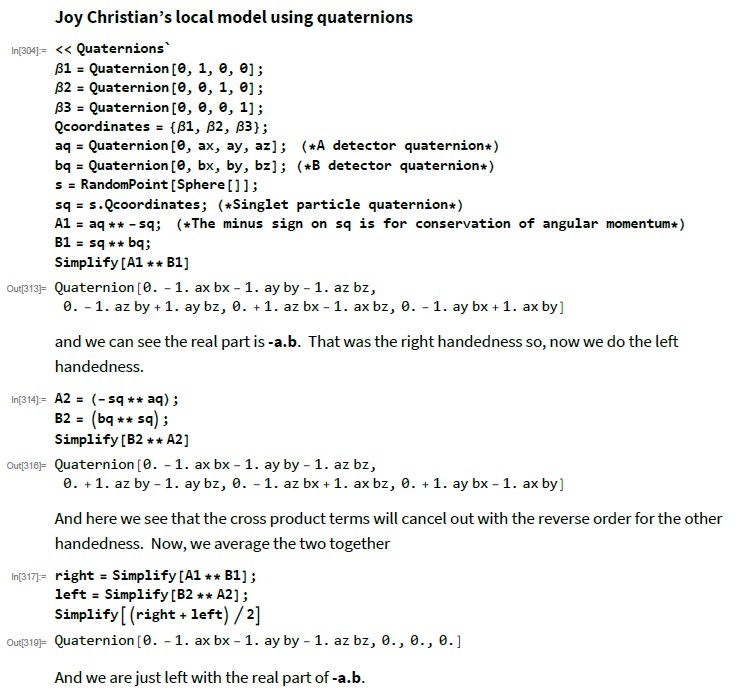
None of this debate matters at all since Bell's theory is shot down by Joy's simple local model.

Image

So the model predicts -a.b just like quantum mechanics via a product calculation.
.
FrediFizzx
Independent Physics Researcher
 
Posts: 2905
Joined: Tue Mar 19, 2013 7:12 pm
Location: N. California, USA

Re: Some people do not understand Counterfactual Definitenes

Postby Joy Christian » Thu Mar 25, 2021 9:27 pm

.
Absolutely, Fred. But let us indulge the mathematicians by demonstrating that their mathematics does not make any physical sense!
.
Joy Christian
Research Physicist
 
Posts: 2793
Joined: Wed Feb 05, 2014 4:49 am
Location: Oxford, United Kingdom

Re: Some people do not understand Counterfactual Definitenes

Postby Joy Christian » Thu Mar 25, 2021 9:50 pm

Justo wrote:
To evaluate we can choose two different methods, we can evaluate mean values first and then sum or we sum and then evaluate the mean


Passing from the second term to the third one does not involve a physical assumption. If there is an assumption here is that arithmetic laws are valid. That is exactly what is assumed in Bell's derivation when the terms are put under the same integral.

There is no problem here as in the case of von Neumann's theorem where it would mean that the sum of eigenvalues is the eigenvalue of the operators sum. Here there are no operators, that is a quantum mechanical issue the which does not correspond to a classical model.

This argument is not correct. You are rationalizing the double-standards used by Bell to hide the major flaw in his argument. Bell ridiculed von Neumann for making the assumption that is hidden in your displayed equation explicitly and then went on to make the same assumption surreptitiously in his own theorem.

von Neumann's theorem is also about hidden variable theories in which there are no operators. All hidden variable theories are about results of measurements that are counterparts of the eigenvalues of quantum mechanical operators.

To justify your rationalization, you would have to prove that local realism + no conspiracy necessitates the second equality in your equation. To claim that it is just assuming that laws of arithmetic are valid is to miss the point Bell himself so eloquently brought out in his criticism of von Neumann's theorem. I highly recommend that you re-read Section 3 of the first chapter of Bell's book. Alternatively, you can read Section II of my paper: https://arxiv.org/pdf/1704.02876.pdf. You will see that your argument fails.
.
Joy Christian
Research Physicist
 
Posts: 2793
Joined: Wed Feb 05, 2014 4:49 am
Location: Oxford, United Kingdom

Re: Some people do not understand Counterfactual Definitenes

Postby gill1109 » Thu Mar 25, 2021 10:45 pm

Joy Christian wrote:
Justo wrote:
To evaluate we can choose two different methods, we can evaluate mean values first and then sum or we sum and then evaluate the mean


Passing from the second term to the third one does not involve a physical assumption. If there is an assumption here is that arithmetic laws are valid. That is exactly what is assumed in Bell's derivation when the terms are put under the same integral.

There is no problem here as in the case of von Neumann's theorem where it would mean that the sum of eigenvalues is the eigenvalue of the operators sum. Here there are no operators, that is a quantum mechanical issue the which does not correspond to a classical model.

This argument is not correct. You are rationalizing the double-standards used by Bell to hide the major flaw in his argument. Bell ridiculed von Neumann for making the assumption that is hidden in your displayed equation explicitly and then went on to make the same assumption surreptitiously in his own theorem.

von Neumann's theorem is also about hidden variable theories in which there are no operators. All hidden variable theories are about results of measurements that are counterparts of the eigenvalues of quantum mechanical operators.

To justify your rationalization, you would have to prove that local realism + no conspiracy necessitates the second equality in your equation. To claim that it is just assuming that laws of arithmetic are valid is to miss the point Bell himself so eloquently brought out in his criticism of von Neumann's theorem. I highly recommend that you re-read Section 3 of the first chapter of Bell's book. Alternatively, you can read Section II of my paper: https://arxiv.org/pdf/1704.02876.pdf. You will see that your argument fails.
.

You are using emotive language (“double-standards”, “ridicule”, “surreptitious”) to disguise the fact that as far as you have an argument, it is incorrect. Once one is working inside a mathematical model one uses the mathematics which is made available.

Anyway, in QM, <A> + <B> = <A +B> whether or not A and B commute. A hidden variable theory which reproduces QM must reproduce this relation too.
gill1109
Mathematical Statistician
 
Posts: 2812
Joined: Tue Feb 04, 2014 10:39 pm
Location: Leiden

Re: Some people do not understand Counterfactual Definitenes

Postby Joy Christian » Thu Mar 25, 2021 10:53 pm

.
The bottom line is that hidden variables + local realism necessitate that . And therefore Bell's argument fails.

Consequently, what is ruled out by the Bell-test experiments is not local realism but the assumption of the additivity of expectation values.
.
Joy Christian
Research Physicist
 
Posts: 2793
Joined: Wed Feb 05, 2014 4:49 am
Location: Oxford, United Kingdom

Re: Some people do not understand Counterfactual Definitenes

Postby Joy Christian » Fri Mar 26, 2021 1:06 am

gill1109 wrote:
Anyway, in QM, <A> + <B> = <A + B> whether or not A and B commute. A hidden variable theory which reproduces QM must reproduce this relation too.

Yes, but a hidden variable version of the QM equation < A > + < B > = < A + B > is not < a > + < b > = < a + b >.

To be precise, let a and b be the eigenvalues of the QM operators A and B, respectively. Then the eigenvalue of the operator A + B is not a + b if A and B do not commute.

Let us say the eigenvalue of the operator A + B is c when A and B do not commute, where c is not equal to a + b.

Then the hidden variable version of the QM equation < A > + < B > = < A + B > is not < a > + < b > = < a + b >, but < a > + < b > = < c >.

To not recognize this for his own theorem is Bell's mistake: https://arxiv.org/pdf/1704.02876.pdf.
.
Joy Christian
Research Physicist
 
Posts: 2793
Joined: Wed Feb 05, 2014 4:49 am
Location: Oxford, United Kingdom

Re: Some people do not understand Counterfactual Definitenes

Postby Justo » Fri Mar 26, 2021 4:22 am

Joy Christian wrote:
gill1109 wrote:Anyway, in QM, <A> + <B> = <A + B> whether or not A and B commute. A hidden variable theory which reproduces QM must reproduce this relation too.

Yes, but a hidden variable version of the QM equation < A > + < B > = < A + B > is not < a > + < b > = < a + b >.

To be precise, let a and b be the eigenvalues of the QM operators A and B, respectively. Then the eigenvalue of the operator A + B is not a + b if A and B do not commute.

Let us say the eigenvalue of the operator A + B is c when A and B do not commute, where c is not equal to a + b.


That's right and is von Neumann's mistake that Bell spotted.

Joy Christian wrote:Then the hidden variable version of the QM equation < A > + < B > = < A + B > is not < a > + < b > = < a + b >, but < a > + < b > = < c >.


That is right when we interpret <A + B> as the mean corresponding to the observable A+B. However, in the Bell inequality, we are not dealing with the operator A + B. The quantum observable A + B is not an issue in the Bell inequality, not even when calculating the quantum prediction. Only the individual observables A and B are evaluated.

The Bell inequality only concerns the means of the separate observables A and B and what hidden variables predict for <A> + <B>, then we write

<A> + <B> = whatever valid mathematical operations allowing us to evaluate <A> + <B>(all that appears here, in the rhs, do not have a literal physical meaning)

Therefore when Bell wrote <A> + <B> = <A + B> he is not assuming that the eigenvalue of the operator A + B is sum of the individual eigenvalues. Again, the observable A + B is not under consideration when dealing with the Bell inequality.

It is the same old problem with the Bell inequality: misinterpreting valid mathematical operations and giving them literal and incorrect physical interpretations.
The one Joy Christian found, in this case, is really original, I don't know of anyone claiming that Bell committed the same mistake as von Neumann.
The incredibly widespread misinterpretation in these cases is that <A + B> implies incompatible experiments.
Justo
 

Re: Some people do not understand Counterfactual Definitenes

Postby Joy Christian » Fri Mar 26, 2021 8:24 am

Justo wrote:
Joy Christian wrote:Then the hidden variable version of the QM equation < A > + < B > = < A + B > is not < a > + < b > = < a + b >, but < a > + < b > = < c >.

That is right when we interpret <A + B> as the mean corresponding to the observable A+B. However, in the Bell inequality, we are not dealing with the operator A + B. The quantum observable A + B is not an issue in the Bell inequality, not even when calculating the quantum prediction. Only the individual observables A and B are evaluated.

In the Bell-test experiments, we are dealing with non-commuting operators. Bell explicitly writes
John S. Bell wrote:
Consider a pair of spin one-half particles formed somehow in the singlet spin state and moving freely in opposite directions. Measurements can be made, say by Stern-Gerlach magnets, on selected components of the Spins and , If measurement Of the component , where is some unit vector, yields the value + 1 then, according to quantum mechanics, measurement of must yield the value -1 and vice versa.

Evidently, and are quantum mechanical operators, and (in Bell's notation) A = +/-1 and B = +/-1 are eigenvalues of these operators.

Justo wrote:
The Bell inequality only concerns the means of the separate observables A and B and what hidden variables predict for <A> + <B>, then we write <A> + <B> = whatever valid mathematical operations allowing us to evaluate <A> + <B>.

The valid mathematical operation is physically meaningless. That is the point of Einstein's, Bell's, and many other scholar's criticisms of von Neumann who used the "valid mathematical operation < A + B >" to derive his conclusion. Bell, after ridiculing von Neumann, went on to use the same physically meaningless mathematical operation to derive Boole's 100-years old inequality, and then made outrageous metaphysical claims based on his incorrect derivation.

Justo wrote:
Therefore when Bell wrote <A> + <B> = <A + B> he is not assuming that the eigenvalue of the operator A + B is sum of the individual eigenvalues. Again, the observable A + B is not under consideration when dealing with the Bell inequality.

This is not correct. Bell is implicitly assuming precisely what you are claiming he is not assuming. The meaning of A + B is quite clear from the above quotation from Bell's 1964 paper.

Justo wrote:
It is the same old problem with the Bell inequality: misinterpreting valid mathematical operations and giving them literal and incorrect physical interpretations.

This is quite correct. You, like many others, have misinterpreted both Bell's inequality and its physical meaning. For its correct interpretation, please read my paper I have linked above.

------------------------------------------------------

PS: For those who do not have time to read my paper, here is the upshot of it. For whatever reason, Bell's derivation of his inequalities involves the additivity of expectation values:

< A > + < B > = < A + B >.

This is an assumption. Whether it is a justified assumption or not is irrelevant. What matters is that without this assumption the derivation of Bell inequalities does not go through.

Now we do the experiments and discover that the bounds of +/-2 on the Bell-CHSH inequalities are exceeded. The only rational conclusion from that is to conclude that the assumption of the additivity of expectation values is ruled out by the experiments. Anything else is pure speculation.
.
Joy Christian
Research Physicist
 
Posts: 2793
Joined: Wed Feb 05, 2014 4:49 am
Location: Oxford, United Kingdom

Re: Some people do not understand Counterfactual Definitenes

Postby Justo » Fri Mar 26, 2021 10:06 am

Joy Christian wrote:
Justo wrote:It is the same old problem with the Bell inequality: misinterpreting valid mathematical operations and giving them literal and incorrect physical interpretations.

This is quite correct. You, like many others, have misinterpreted both Bell's inequality and its physical meaning. For its correct interpretation, please read my paper I have linked above.
.


Yes, I read your paper but I do not agree. Maybe we reached a deadlock. I will try to explain it differently.

You claim that when using hidden variables and deterministic functions A and B, <A>+<B>=<A+B> is incorrect. I said that it is not. It is confusing because we are both right.
You are right if the objective is to calculate the mean of one operator O=A + B. Bell observed that we cannot assume <O>=<A+B> when A and B are given by real functions and operators A,B do not commute.
However, if we do not want to evaluate the mean of the operator O=A + B but we want to calculate the independent means of two different operators A and B, when the values of these operators are given by two functions A(a,\lambda) and B(b,\lambda) then it is correct to write <A> + <B> = <A + B> because we are not evaluating the mean of the operator A + B. In this case, the passage from the l.h.s. to r.h.s is just a valid arithmetic operation.

Thus, it is very important to distinguish between the physical meaning of <A + B> =<O> as the mean of the operator O and <A + B> as a mathematical expression to evaluate the sum of two different operators A and B.

In the Bell inequality, we are concern with different experiments giving different results with different means <A> and <B>. More specifically the Bell inequality concerns four different experiments executed independently. Those experiments are repeated many times to obtain a mean for each one of them so we have four different series of experiments.
Your claim would be correct if the Bell experiment consisted of a single series of experiments that measure only one observable each time, namely O=A+B.
However, Bell did not want predict the mean of a single operator.
Justo
 

Re: Some people do not understand Counterfactual Definitenes

Postby Joy Christian » Fri Mar 26, 2021 12:31 pm

.
My approach to Bell's derivation of the Bell-CHSH inequalities resembles the trouble-shooting of an experiment that has yielded a bizarre result. A systematic error has probably occurred, one of the commonest being an inadvertent introduction of impurities in the observed specimen of material. An insertion of impurities into the material of a thought experiment is a rather unusual occurrence, but that is precisely what Bell has done. It is his assumption of the additivity of expectation values that is the impurity that has contaminated his thought experiment.
.
Joy Christian
Research Physicist
 
Posts: 2793
Joined: Wed Feb 05, 2014 4:49 am
Location: Oxford, United Kingdom

Re: Some people do not understand Counterfactual Definitenes

Postby gill1109 » Sat Mar 27, 2021 8:59 pm

Consider three observables A, B and C such that C = A + B. Suppose none commute with one another. There are three separate experiments which allow one to experimentally determine <A>, <B>, and <C>, each by averaging many measurements of A, B or C on systems prepared in the same state rho. One will discover that <C> = <A> + <B>.

This is because <A> = trace(rho A), <B> = trace(rho B), <C> = trace(rho C), “trace” is linear.

A hidden variable model for these experiments is a classical probability space with three random variables X, Y and Z defined on it, such that the probability distributions of the three random variables exactly reproduce the probability distributions of the outcomes of measurements of the three observables. In particular, their mean values are the same. Hence E(X) = <A>, E(Y) = <B>, E(Z) = <C>. Hence E(X) + E(Y) = E(Z).

The additivity follows from the linearity of the trace operator. The hidden variable model by definition mimics observable features of the quantum model (probabilities, expectation values...).

It is good that critical scientists challenge accepted wisdom but I’m afraid that Joy can’t get around this point so easily.
gill1109
Mathematical Statistician
 
Posts: 2812
Joined: Tue Feb 04, 2014 10:39 pm
Location: Leiden

Re: Some people do not understand Counterfactual Definitenes

Postby Joy Christian » Sat Mar 27, 2021 9:13 pm

.
Gill's argument above was dismissed by Einstein when Bell was hardly seven years old. The additivity of expectation values simply does not hold for any hidden variable theories.

The Bell-test experiments are verifying Einstein's observation and ruling out the additivity of expectation values. This is the sad end of Bell's theorem. Sadly, it was a nonstarter.
.
Joy Christian
Research Physicist
 
Posts: 2793
Joined: Wed Feb 05, 2014 4:49 am
Location: Oxford, United Kingdom

PreviousNext

Return to Sci.Physics.Foundations

Who is online

Users browsing this forum: ahrefs [Bot] and 163 guests

CodeCogs - An Open Source Scientific Library