Page 1 of 1

Gisin and Gisin Simulation by John Reed

PostPosted: Sun Mar 02, 2014 2:24 pm
by FrediFizzx
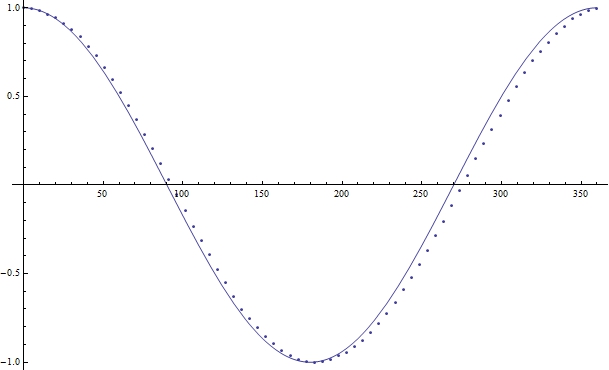
John Reed has done the Gisin and Gisin simulation in Mathematica at 5 degree increments and 10,000 trials. Here are links to the Mathematica notebook file and a PDF for those that don't have Mathematica.

EPRsims/GisinReed.pdf
EPRsims/GisinReed.nb

And the result is,

Image

Re: Gisin and Gisin Simulation by John Reed

PostPosted: Sun Mar 02, 2014 2:54 pm
by Joy Christian
FrediFizzx wrote:John Reed has done the Gisin and Gisin simulation in Mathematica at 5 degree increments and 10,000 trials.


The Gisin and Gisin model is manifestly nonlocal. As Michel noted in another thread, in their theoretical derivation Alice's measurement setting depends on knowing Bob's measurement setting. This non-locality is hidden in their supposedly "convenient" choice of a "reference frame" to calculate the correlation.

In addition to this, Alice's outcomes are determined by first tossing a coin for Bob's outcomes, and then deducing Alice's outcomes from the knowledge of Bob's outcomes. This is hidden in plain sight in their choice of a joint probability distribution. Thus, despite having exploited the detection loophole, they have ended up producing a manifestly nonlocal model after all.

Finally, from the above simulation it looks like the cosine curve their model produces is not perfect either.

Re: Gisin and Gisin Simulation by John Reed

PostPosted: Sun Mar 02, 2014 8:41 pm
by gill1109
http://rpubs.com/gill1109/Gisin2opt

Image

Michel's idea that the simulation was non-local is mistaken. He did not understand something he read in their paper, about the directions in the two measurement stations having to be set up in advance. The simulation program is as local as any other we have been discussing.

Re: Gisin and Gisin Simulation by John Reed

PostPosted: Sun Mar 02, 2014 10:17 pm
by Joy Christian
gill1109 wrote:The simulation program is as local as any other we have been discussing.


This is incorrect. The Gisin and Gisin model is nonlocal. They explicitly state:

"Next, we need the conditional density probability distribution of the ~λA given that an outcome is produced: ρ(~λ | outcome produced)..."

This contradicts Bell's definition of locality, according to which ρ(λ) must depend only on the common cause λ. It must be independent, not only of the settings a and b, but also of the outcomes A and B. Thus Bell would regard the Gisin and Gisin model non-local, because their probability density ρ(λ) depends on the outcomes A.

Re: Gisin and Gisin Simulation by John Reed

PostPosted: Mon Mar 03, 2014 1:48 am
by gill1109
Joy Christian wrote:
gill1109 wrote:The simulation program is as local as any other we have been discussing.


This is incorrect. The Gisin and Gisin model is nonlocal. They explicitly state:

"Next, we need the conditional density probability distribution of the ~λA given that an outcome is produced: ρ(~λ | outcome produced)..."

This contradicts Bell's definition of locality, according to which ρ(λ) must depend only on the common cause λ. It must be independent, not only of the settings a and b, but also of the outcomes A and B. Thus Bell would regard the Gisin and Gisin model non-local, because their probability density ρ(λ) depends on the outcomes A.

Don't take any notice of the words they say. Read the formulas, only, Or: read the code of the simulation model. It is manifestly local.

Hidden variable: random point on the sphere, auxiliary independent uniform [0, 1] random variable, auxiliary independent coin toss.

Generate these three objects and send them all off both to Alice and to Bob's place.
Alice and Bob's measurement stations each look at the inner product of the angle between their measurement direction and the direction of the spin.

If the coin toss said heads:
Alice's station generates an outcome "sign of inner product"
Bob's station generates an outcome "sign of inner product" provided uniform is smaller than absolute value of inner product, otherwise says "no state"

If the coin said tails:
Bob's station generates an outcome "sign of inner product"
Alice's station generates an outcome "sign of inner product" provided uniform is smaller than absolute value of inner product, otherwise says "no state"

Just as in the case of Pearle's paper, one must distinguish between the model specification, and any theoretical computations which we might want to do for a given model. The model is just the recipe for the simulation program. The instructions to the programmer. They are very simple.

Re: Gisin and Gisin Simulation by John Reed

PostPosted: Mon Mar 03, 2014 4:03 am
by gill1109
Here is another example of perfection:

Now this is perfection: Pearle (1970)

http://rpubs.com/gill1109/Pearle

Maybe Fred likes to program it in Mathematica (or get John Reed to do that for him)

Re: Gisin and Gisin Simulation by John Reed

PostPosted: Mon Mar 03, 2014 5:10 am
by Joy Christian
gill1109 wrote:Here is another example of perfection:

Now this is perfection: Pearle (1970)

http://rpubs.com/gill1109/Pearle

Maybe Fred likes to program it in Mathematica (or get John Reed to do that for him)


There is a crucial difference between the latest R-based simulations and the Mathematica version Fred has been playing with---3D versus 2D. Just a reminder!

Re: Gisin and Gisin Simulation by John Reed

PostPosted: Mon Mar 03, 2014 6:06 am
by gill1109
Joy Christian wrote:
gill1109 wrote:Here is another example of perfection:

Now this is perfection: Pearle (1970)

http://rpubs.com/gill1109/Pearle

Maybe Fred likes to program it in Mathematica (or get John Reed to do that for him)


There is a crucial difference between the latest R-based simulations and the Mathematica version Fred has been playing with---3D versus 2D. Just a reminder!

Yes that's an important point! :) Another difference: the first simulations simulated A times B. The newer ones do A and B separately.

Re: Gisin and Gisin Simulation by John Reed

PostPosted: Mon Mar 03, 2014 8:00 am
by jreed
gill1109 wrote:Here is another example of perfection:

Now this is perfection: Pearle (1970)

http://rpubs.com/gill1109/Pearle

Maybe Fred likes to program it in Mathematica (or get John Reed to do that for him)


I've been curious about Pearle's simulation. I'll program that up. Thanks for the code. Do you have a copy of Pearle's paper? I could get it for $25 from APS, but if I could get a free copy that would save me some money.

Re: Gisin and Gisin Simulation by John Reed

PostPosted: Mon Mar 03, 2014 8:05 am
by Joy Christian
jreed wrote:
gill1109 wrote:Here is another example of perfection:

Now this is perfection: Pearle (1970)

http://rpubs.com/gill1109/Pearle

Maybe Fred likes to program it in Mathematica (or get John Reed to do that for him)


I've been curious about Pearle's simulation. I'll program that up. Thanks for the code. Do you have a copy of Pearle's paper? I could get it for $25 from APS, but if I could get a free copy that would save me some money.


We cannot post it on this site or anywhere else. That would be copyright violation. But if you send me an email at jjc@alum.bu.edu, I will send you a copy, legally.

Re: Gisin and Gisin Simulation by John Reed

PostPosted: Mon Mar 03, 2014 11:54 am
by FrediFizzx
Hi Joy,

Please send to me also. Thanks.

Fred

Re: Gisin and Gisin Simulation by John Reed

PostPosted: Tue Mar 04, 2014 11:01 pm
by gill1109
Very difficult paper to read, but a little masterpiece. Spectacular. Boy, could they do analysis in the old days!