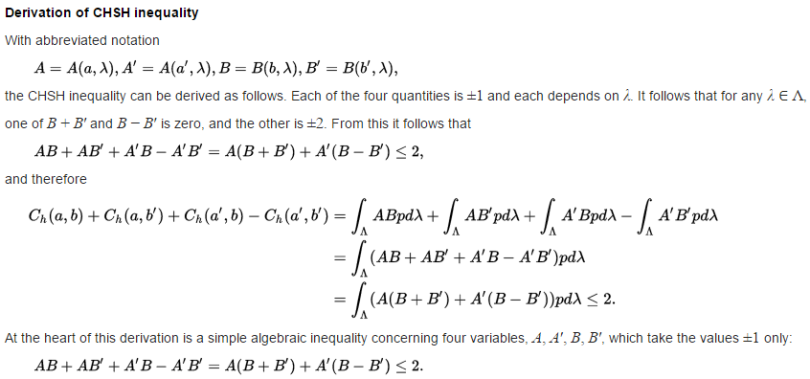
The background has already been given in previous posts, but
for convenience will be summarized below. But first I'll present
the suggestions in the hope that readers may remember or guess enough
to follow the discussion.
1) In a previous post I wrote down four hypothetical "marginals"
which are derived from a quantum state (|1>|1> + |-1>|-1>)/\sqrt{2} :
(In case you've forgotten what "hypothetical marginal" means in this context,
I'll summarize later.)
Previous posts have noted that showing that there is a "local realistic"
theory that can reproduce quantum mechanics just for this state is
equivalent to showing that these hypothetical marginals are true marginals
for some probability distribution on the set of 16 outcomes (i,j,k,m)
where the entries i,j,k,m take on the values +1 or -1.
Some people claim to be able to prove that the desired distribution
p(i,j,k,m) does exist. The claimed proof is written in different notation
which makes it difficult for me to extract its claimed p in explicit form.
But for such simple hypothetical marginals, one would expect that if such
a p exists, it ought to be possible to find it explicitly.
An explicit presentation would only require specifying 16 probabilities
from which one could easily check by hand that they do indeed yield the
hypothetical marginals as true marginals. Taking into account the Alice-Bob
symmetry of the underlying quantum state and the fact that all the probabilities
must sum to 1, actually only 7 probabilities need be specified.
Someone who is more familiar with the proof than I (assuming for the sake of
discussion that the proof is correct) may be able to immediately write down p .
Or, if not, then the problem of finding p explicitly
looks like an interesting new line of research. In general, one would hope
for an algorithm for p which would apply to any quantum state, not just
the particular one given above.
If the proponents of the proof could explicitly produce p ,
that would instantly demolish any suspicions that the proof must be wrong
because it contradicts the conclusion of Bell's theorem.
(It would not prove that the proof is correct for general states,
but then at least people would take it seriously.)
That p reproduces the hypothetical marginals as true marginals
would be indisputable because it could be checked by simple arithmetic
which could be done by hand in a few minutes. Few will argue with
arithmetic!
Production of p would also show beyond any doubt that traditional
proofs of Bell's theorems are wrong. This would be huge news that
would rock the scientific world, given that many consider Bell's Theorem,
simple as it is, one of the major scientific advances in centuries.
In short, my first suggestion is that those who believe that local realistic
theories can reproduce quantum mechanics should demonstrate the truth of
a small part of their belief by explicitly exhibiting p for the above
simple marginals. Those marginals do not satisfy the hypotheses of
several forms of Bell's theorem, so that p would be an indisputable
counterexample to Bell's theorem.
2) This suggestion will describe a simple experiment that anyone with
a computer algebra system (such as Mathematica, Maple, or one of the free
systems like MacSyma) can do to try to find a p which reproduces the
hypothetical marginals.
As noted above, to find p it is enough to find seven probabilities
which satisfy some inhomogeneous linear equations. There are four
marginals, each with four entries, so there are 4x4=16 equations in all
for the 7 unknowns. Generically, we wouldn't expect a solution to 16 linear
equations in only 7 unknowns, but the way the equations were obtained
and the symmetries of the hypothetical marginals gives hope
that a solution might be possible.
Looking at it another way, we could go back to our original 16 probabilities
as unknowns, adjoin one equation specifying that the probabilities
sum to 1, and obtain 16+1=17 equations in 16 unknowns, which looks not
so overdetermined.
It would probably take less than an hour to type the linear system into
a computer algebra system. Because the entries of the hypothetical
marginals are rational numbers, an exact solution will be obtained if
the system is consistent.
If the system of equations is inconsistent (i.e., has no solution),
the computer algebra program will report that. That will show that
there is no local realistic theory (according to all definitions
that I have seen) which can reproduce the predictions of quantum mechanics
for the above state. This is the conclusion of Bell's theorems whose
usual proofs I believe to be correct, so this is what I think will happen.
(I have not invested the time to actually do the experiment because
I am so sure of the outcome!)
If the system proves consistent, the algebra program will give it explicitly,
but there will be more to be done because we need a solution for which
all probabilities are non-negative. This converts the problem into one
of so-called "linear programming", about which I know little, but I wouldn't
be surprised if computer algebra programs could do that, too. (The manual
for mine just says that it will "try" to find a solution!)
Even if not, the problem is so small that given the explicit solution,
one might be able to find a non-negative solution by hand.
If so, that would settle by explicit arithmetic that Bell's theorem is incorrect.
It would suggest, but not prove, that perhaps local realistic theories might reproduce
the predictions of quantum mechanics, thus shattering a belief almost universally
held among professional physicists. The effort involved seems small enough that it seems
worth a try by the "anti-Bellians" given that debate within this forum seems to have reached an impasse.
I chose the above marginals because of their numerical simplicity,
to produce a concrete context within which the Bell's theorem debate
in this forum might be settled without controversy.
Of course, explicitly exhibiting p for those particular marginals
would not prove that one could find p for all marginals
predicted by quantum mechanics for all quantum states.
But it would suggest hope for that possibility.
______________________________________________________________________
The rest of this post summarizes previus posts.
Consider a probability distribution p = p(i,j,k,m) defined on the
set of all 4-tuples (i,j,k,m) with each entry
i,j,k,m equal to either +1 or -1.
For example, a typical outcome is (+1, -1, -1, +1).
Its first entry +1 may be regarded as the result of measuring a quantity
which we denote A, the second as the result of measuring a quantity A',
the third of measuring B, and the fourth of measuring B'.
From p we can derive various "marginal" probability distributions,
"marginals" for short, an example of which is
where the sum ranges over all possible j and m (each being +1 or -1).
Marginals pAB', pA'B , and PA'B' are defined similarly. (There
are other marginals as well, but we will not be concerned with them.)
Consider the following purely mathematical question:
Given four probability distributions pAB , pAB' , pA'B , and pA'B'
on the probability space consisting of all ordered pairs (u,v) with
entries +1 or -1,
does there exist a p = p(i,j,k,m) for which these are the corresponding
marginals?
Of course, the answer will depend on the given (hypothetical) marginals;
for some marginals it might be possible and for others impossible.
There is a mathematical theorem giving necessary and sufficient conditions
for the existence of p , but to make my question as concrete
as possible, consider a numerical special case.
Consider the following "hypothetical marginals" pAB and pA'B,
presented as 2x2 matrices:
'
This presentation is to be interpreted according to the usual matrix
convention that pAB(1,1) = 3/8 = pAB(-1,-1) , pAB(1,-1) = 1/8 = pAB(-1,1) ,
etc. I call them "hypothetical marginals" because we cannot assume,
a priori, that they can be derived from some p = p(i,j,k,m) .
They are just four 2x2 matrices that we can write down.
Continuing, define
The following is a purely mathematical theorem with a simple proof
which has surely been checked by thousands of mathematicians.
I, myself, have checked it and consider the possibility of an error
in its proof as similar to the probability of an error in the Binomial
Theorem. It has nothing to do with physical measurements, though
it can be interpreted in that context.
Theorem: There is no probability distribution p(i,j,k,m) which
yields the above hypothetical marginals pAB , pA'B , pAB' , pA'B'
as true marginals.
The theorem is a special case of Bell's theorem.
Despite the simplicity of its statement and proof,
it is considered one of the most important scientific
advances of the past centuries. If it is false or even if there is
any mistake in any of its accepted proofs, that will be huge news,
shaking the scientific establishment to its roots.
Some theorems have proofs so complicated that their status
(true or unproved or false) remains in doubt for years.
To show that a theorem is false, it is sufficient to produce a counterexample.
This is often easier than arguing about a complicated proof which few
understand.
Some members of this forum believe that accepted proofs
of the above theorem are false,
and others vigorously dispute that claim.
Somebody who wants the fame of rocking the scientific establishment
would probably be well-advised to look for a counterexample when arguments
about established proofs have proved inconclusive.