A real EPR-Bohm scenario

Foundations of physics and/or philosophy of physics, and in particular, posts on unresolved or controversial issues

Re: A real EPR-Bohm scenario

Postby Joy Christian » Mon Dec 05, 2016 12:39 pm

***
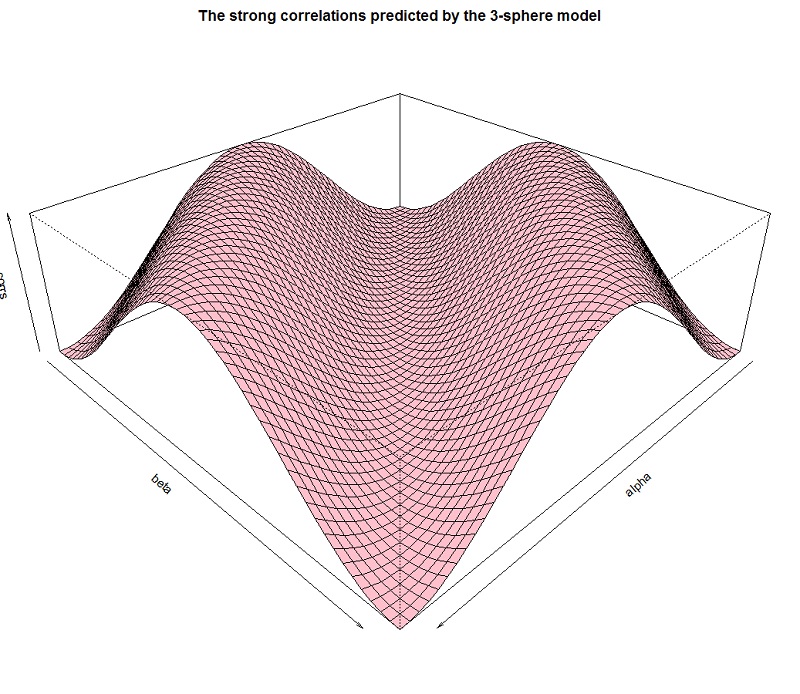
I have simplified the code a bit so that I can understand what you are saying:

Code: Select all
Angles = seq(from = 0, to = 360, by = 7.2) * 2 * pi/360

K = length(Angles) # The total number of angles between 0 and 2pi

corrs = matrix(nrow = K, ncol = K, data = 0) # Container for correlations

M = 10^4 # Size of the pre-ensemble. Next one can try 10^5, or even 10^6

r = runif(M, 0, 2*pi) # M uniformly distributed numbers between 0 and 2pi

z = runif(M, -1, +1) # M uniformly distributed numbers between -1 and +1

h = sqrt(1 - z^2)

x = h * cos(r)

y = h * sin(r)

e = rbind(x, y, z)

s = runif(M, 0, pi) # Initial states of the spins are the pairs (e, s) within S^3

f = -1 + (2/sqrt(1 + ((3 * s)/pi))) # For details see the paper arXiv:1405.2355

g = function(u,v,s){ifelse(abs(colSums(u*v)) > f, cos(Angles), 0)}

d = function(p,q){ifelse(2*acos(colSums(p*q)) < pi, 1, -1)}

for (i in 1:K) {
 
  alpha = Angles[i]
  a = c(cos(alpha), sin(alpha), 0)  # Measurement direction 'a'
 
  for (j in 1:K) {
   
    beta = Angles[j]
   
    b = c(cos(beta), sin(beta), 0)  # Measurement direction 'b'
   
    A = +sign(d(a,e)*g(a,e,s))  # Alice's measurement results A(a, e, s) = +/-1
   
    B = -sign(d(b,e)*g(b,e,s))  # Bob's measurement results B(b, e, s) = -/+1
   
    N = length((A*B)[A & B]) # Number of all possible events observed in S^3
   
    corrs[i,j] = sum(A*B)/N  # Product moment correlation coefficient E(a, b)
   
  }
}

par(mar = c(0, 0, 2, 0))
persp(x = Angles, y = Angles, main = "The strong correlations predicted by the 3-sphere model", z = corrs, zlim = c(-1, 1), col = "pink", theta = 135, phi = 30, scale = FALSE, xlab = "alpha", ylab = "beta")


***
Joy Christian
Research Physicist
 
Posts: 2793
Joined: Wed Feb 05, 2014 4:49 am
Location: Oxford, United Kingdom

Re: A real EPR-Bohm scenario

Postby Joy Christian » Mon Dec 05, 2016 12:46 pm

FrediFizzx wrote:IOW, I have to contend that your eqs. (60) and (64) are not exactly correct.


So according to eq. (59) we have,


Why would we always have the cos(0)?

Because in the paper A is obtained in the limit s1 --> a.

***
Last edited by Joy Christian on Mon Dec 05, 2016 1:55 pm, edited 1 time in total.
Joy Christian
Research Physicist
 
Posts: 2793
Joined: Wed Feb 05, 2014 4:49 am
Location: Oxford, United Kingdom

Re: A real EPR-Bohm scenario

Postby FrediFizzx » Mon Dec 05, 2016 1:39 pm

Joy Christian wrote:***
I have simplified the code a bit so that I can understand what you are saying:

Code: Select all
Angles = seq(from = 0, to = 360, by = 7.2) * 2 * pi/360

K = length(Angles) # The total number of angles between 0 and 2pi

corrs = matrix(nrow = K, ncol = K, data = 0) # Container for correlations

M = 10^4 # Size of the pre-ensemble. Next one can try 10^5, or even 10^6

r = runif(M, 0, 2*pi) # M uniformly distributed numbers between 0 and 2pi

z = runif(M, -1, +1) # M uniformly distributed numbers between -1 and +1

h = sqrt(1 - z^2)

x = h * cos(r)

y = h * sin(r)

e = rbind(x, y, z)

s = runif(M, 0, pi) # Initial states of the spins are the pairs (e, s) within S^3

f = -1 + (2/sqrt(1 + ((3 * s)/pi))) # For details see the paper arXiv:1405.2355

g = function(u,v,s){ifelse(abs(colSums(u*v)) > f, cos(Angles), 0)}

d = function(p,q){ifelse(2*acos(colSums(p*q)) < pi, 1, -1)}

for (i in 1:K) {
 
  alpha = Angles[i]
  a = c(cos(alpha), sin(alpha), 0)  # Measurement direction 'a'
 
  for (j in 1:K) {
   
    beta = Angles[j]
   
    b = c(cos(beta), sin(beta), 0)  # Measurement direction 'b'
   
    A = +sign(d(a,e)*g(a,e,s))  # Alice's measurement results A(a, e, s) = +/-1
   
    B = -sign(d(b,e)*g(b,e,s))  # Bob's measurement results B(b, e, s) = -/+1
   
    N = length((A*B)[A & B]) # Number of all possible events observed in S^3
   
    corrs[i,j] = sum(A*B)/N  # Product moment correlation coefficient E(a, b)
   
  }
}

par(mar = c(0, 0, 2, 0))
persp(x = Angles, y = Angles, main = "The strong correlations predicted by the 3-sphere model", z = corrs, zlim = c(-1, 1), col = "pink", theta = 135, phi = 30, scale = FALSE, xlab = "alpha", ylab = "beta")


***

Yes, that is better.
FrediFizzx
Independent Physics Researcher
 
Posts: 2905
Joined: Tue Mar 19, 2013 7:12 pm
Location: N. California, USA

Re: A real EPR-Bohm scenario

Postby FrediFizzx » Mon Dec 05, 2016 6:26 pm

Joy Christian wrote:
FrediFizzx wrote:IOW, I have to contend that your eqs. (60) and (64) are not exactly correct.


So according to eq. (59) we have,


Why would we always have the cos(0)?

Because in the paper A is obtained in the limit s1 --> a.

***

Of course. Wrong question. Why the cos(a - s_1) and not just cos(a)? What is the physical significance of the angle (a - s_1)? With the polarizers included, that angle can be done away with and you just have cos(a). So A = sign(+/-cos(a)) gives you everything you need plus more. There is no need for a third angle (a - s_1) being involved. Which goes to (a - s_1) = 0 in the limit and is still a third angle involved.

Well, of course (a - s_1) must have some physical significance since it is involved in complete state selection and polarizer action.
.
FrediFizzx
Independent Physics Researcher
 
Posts: 2905
Joined: Tue Mar 19, 2013 7:12 pm
Location: N. California, USA

Re: A real EPR-Bohm scenario

Postby Joy Christian » Tue Dec 06, 2016 7:17 am

***
I have changed the notation slightly. In the R code below we have the following local-realistic variables, where (e, s) is the initial state (or the hidden variables):


where h(a, e) = +1 if (a - e) < pi, -1 otherwise. And g(a, e, s) = cos(a) if (a - e) > f, 0 otherwise; where f is a function of s.


where h(b, e) = +1 if (b - e) < pi, -1 otherwise. And g(b, e, s) = cos(b) if (b - e) > f, 0 otherwise; where f is a function of s.

Thus we have the following local pair of measurement outcomes:


and


which give the correlations E(a, b) = -a.b within the 3-sphere. This is essentially the same simulation of the 3-sphere model, but written somewhat differently:

Code: Select all
Angles = seq(from = 0, to = 360, by = 7.2) * 2 * pi/360

K = length(Angles) # The total number of angles between 0 and 2pi

corrs = matrix(nrow = K, ncol = K, data = 0) # Container for correlations

M = 10^4 # Size of the pre-ensemble. Next one can try 10^5, or even 10^6

r = runif(M, 0, 2*pi) # M uniformly distributed numbers between 0 and 2pi

z = runif(M, -1, +1) # M uniformly distributed numbers between -1 and +1

d = sqrt(1 - z^2)

x = d * cos(r)

y = d * sin(r)

e = rbind(x, y, z)

s = runif(M, 0, pi) # Initial states of the spins are the pairs (e, s) within S^3

f = -1 + (2/sqrt(1 + ((3 * s)/pi))) # For details see the paper arXiv:1405.2355

g = function(u,v,s){ifelse(abs(colSums(u*v)) > f, cos(Angles), 0)}

h = function(p,q){ifelse(2*acos(colSums(p*q)) < pi, 1, -1)}

for (i in 1:K) {
 
  alpha = Angles[i]
 
  a = c(cos(alpha), sin(alpha), 0)  # Measurement direction 'a'
 
  for (j in 1:K) {
   
    beta = Angles[j]
   
    b = c(cos(beta), sin(beta), 0)  # Measurement direction 'b'
   
    A = +sign(h(a,e)*g(a,e,s))  # Alice's measurement results A(a, e, s) = +/-1
   
    B = -sign(h(b,e)*g(b,e,s))  # Bob's measurement results B(b, e, s) = -/+1
   
    N = length((A*B)[A & B]) # Number of all possible events observed in S^3
   
    corrs[i,j] = sum(A*B)/N  # Product moment correlation coefficient E(a, b)
   
  }
}

par(mar = c(0, 0, 2, 0))
persp(x = Angles, y = Angles, main = "The strong correlations predicted by the 3-sphere model", z = corrs, zlim = c(-1, 1), col = "lightblue1", theta = 135, phi = 30, scale = FALSE, xlab = "alpha", ylab = "beta")


Image
***
Joy Christian
Research Physicist
 
Posts: 2793
Joined: Wed Feb 05, 2014 4:49 am
Location: Oxford, United Kingdom

Re: A real EPR-Bohm scenario

Postby FrediFizzx » Tue Dec 06, 2016 8:55 am

Clean. As I mentioned in the email, the other (old) g-function must have the polarizer action contained within it. Problem is that I can't yet figure out how. :?
FrediFizzx
Independent Physics Researcher
 
Posts: 2905
Joined: Tue Mar 19, 2013 7:12 pm
Location: N. California, USA

Re: A real EPR-Bohm scenario

Postby Joy Christian » Tue Dec 06, 2016 9:34 am

FrediFizzx wrote:Clean. As I mentioned in the email, the other (old) g-function must have the polarizer action contained within it. Problem is that I can't yet figure out how. :?

What you discovered is that the old g-function can be factorized --- at least in the simulation of S^3 --- as a product of two functions: g(old) = h*g(new). That is neat.

***
Joy Christian
Research Physicist
 
Posts: 2793
Joined: Wed Feb 05, 2014 4:49 am
Location: Oxford, United Kingdom

Re: A real EPR-Bohm scenario

Postby FrediFizzx » Tue Dec 06, 2016 10:08 am

Joy Christian wrote:
FrediFizzx wrote:Clean. As I mentioned in the email, the other (old) g-function must have the polarizer action contained within it. Problem is that I can't yet figure out how. :?

What you discovered is that the old g-function can be factorized --- at least in the simulation of S^3 --- as a product of two functions: g(old) = h*g(new). That is neat.

***

Yes, if two different processes give the same result, they must be equivalent. It is also good to find out that the polarizers were there but hidden. And they are hidden pretty good in the old way. :)
FrediFizzx
Independent Physics Researcher
 
Posts: 2905
Joined: Tue Mar 19, 2013 7:12 pm
Location: N. California, USA

Re: A real EPR-Bohm scenario

Postby FrediFizzx » Tue Dec 06, 2016 12:57 pm

I just realized that I actually have the Mathematica version a little bit different.


where h(a, e) = +1 if (a - e) < pi, -1 otherwise. And g(a, e, s) = cos(a) if (cos(a*h)) > f, 0 otherwise; where f is a function of s.

I going to try this in R to see what happens.
FrediFizzx
Independent Physics Researcher
 
Posts: 2905
Joined: Tue Mar 19, 2013 7:12 pm
Location: N. California, USA

Re: A real EPR-Bohm scenario

Postby FrediFizzx » Tue Dec 06, 2016 2:59 pm

FrediFizzx wrote:I just realized that I actually have the Mathematica version a little bit different.


where h(a, e) = +1 if (a - e) < pi, -1 otherwise. And g(a, e, s) = cos(a) if (cos(a*h)) > f, 0 otherwise; where f is a function of s.

I going to try this in R to see what happens.

Hmm... can't figure out how to do this in R as the lengths don't match up. But tried the R version in Mathematica and it doesn't work. So another mystery to figure out.
FrediFizzx
Independent Physics Researcher
 
Posts: 2905
Joined: Tue Mar 19, 2013 7:12 pm
Location: N. California, USA

Re: A real EPR-Bohm scenario

Postby Joy Christian » Tue Dec 06, 2016 3:03 pm

FrediFizzx wrote:
FrediFizzx wrote:I just realized that I actually have the Mathematica version a little bit different.


where h(a, e) = +1 if (a - e) < pi, -1 otherwise. And g(a, e, s) = cos(a) if (cos(a*h)) > f, 0 otherwise; where f is a function of s.

I going to try this in R to see what happens.

Hmm... can't figure out how to do this in R as the lengths don't match up. But tried the R version in Mathematica and it doesn't work. So another mystery to figure out.

There is a factor of 1/2 wrong in h(a,e). It should be h(a, e) = +1 if (a - e) < pi/2, -1 otherwise.

Alternatively, you can define the h-function in R as h = function(p,q){sign(colSums(p*q))}.

***
Joy Christian
Research Physicist
 
Posts: 2793
Joined: Wed Feb 05, 2014 4:49 am
Location: Oxford, United Kingdom

Re: A real EPR-Bohm scenario

Postby Joy Christian » Tue Dec 06, 2016 4:00 pm

***
Hi Fred, How about this code:

Code: Select all
Angles = seq(from = 0, to = 360, by = 7.2) * 2 * pi/360

K = length(Angles) # The total number of angles between 0 and 2pi

corrs = matrix(nrow = K, ncol = K, data = 0) # Container for correlations

M = 10^4 # Size of the pre-ensemble. Next one can try 10^5, or even 10^6

r = runif(M, 0, 2*pi) # M uniformly distributed numbers between 0 and 2pi

z = runif(M, -1, +1) # M uniformly distributed numbers between -1 and +1

d = sqrt(1 - z^2)

x = d * cos(r)

y = d * sin(r)

e = rbind(x, y, z)

s = runif(M, 0, pi) # Initial states of the spins are the pairs (e, s) within S^3

f = -1 + (2/sqrt(1 + ((3 * s)/pi))) # For details see the paper arXiv:1405.2355

h = function(p,q){colSums(p*q)}

g = function(u,v,s){ifelse(abs(h(u,v)) > f, cos(Angles), 0)}

for (i in 1:K) {
 
  alpha = Angles[i]
 
  a = c(cos(alpha), sin(alpha), 0)   # Alice's measurement direction 'a'
 
  for (j in 1:K) {
   
    beta = Angles[j]
   
    b = c(cos(beta), sin(beta), 0)    #  Bob's measurement direction 'b'
   
    A = +sign(h(a,e))*sign(g(a,e,s))  # Alice's results A(a, e, s) = +/-1
   
    B = -sign(h(b,e))*sign(g(b,e,s))   #  Bob's results B(b, e, s) = -/+1
   
    N = length((A*B)[A & B]) # Number of all possible events observed in S^3
   
    corrs[i,j] = sum(A*B)/N  # Product moment correlation coefficient E(a, b)
   
  }
}

par(mar = c(0, 0, 2, 0))
persp(x = Angles, y = Angles, main = "The strong correlations predicted by the 3-sphere model", z = corrs, zlim = c(-1, 1), col = "khaki", theta = 135, phi = 30, scale = FALSE, xlab = "alpha", ylab = "beta")


***
Joy Christian
Research Physicist
 
Posts: 2793
Joined: Wed Feb 05, 2014 4:49 am
Location: Oxford, United Kingdom

Re: A real EPR-Bohm scenario

Postby FrediFizzx » Tue Dec 06, 2016 8:21 pm

Joy Christian wrote:***
Hi Fred, How about this code:

Code: Select all
Angles = seq(from = 0, to = 360, by = 7.2) * 2 * pi/360

K = length(Angles) # The total number of angles between 0 and 2pi

corrs = matrix(nrow = K, ncol = K, data = 0) # Container for correlations

M = 10^4 # Size of the pre-ensemble. Next one can try 10^5, or even 10^6

r = runif(M, 0, 2*pi) # M uniformly distributed numbers between 0 and 2pi

z = runif(M, -1, +1) # M uniformly distributed numbers between -1 and +1

d = sqrt(1 - z^2)

x = d * cos(r)

y = d * sin(r)

e = rbind(x, y, z)

s = runif(M, 0, pi) # Initial states of the spins are the pairs (e, s) within S^3

f = -1 + (2/sqrt(1 + ((3 * s)/pi))) # For details see the paper arXiv:1405.2355

h = function(p,q){colSums(p*q)}

g = function(u,v,s){ifelse(abs(h(u,v)) > f, cos(Angles), 0)}

for (i in 1:K) {
 
  alpha = Angles[i]
 
  a = c(cos(alpha), sin(alpha), 0)   # Alice's measurement direction 'a'
 
  for (j in 1:K) {
   
    beta = Angles[j]
   
    b = c(cos(beta), sin(beta), 0)    #  Bob's measurement direction 'b'
   
    A = +sign(h(a,e))*sign(g(a,e,s))  # Alice's results A(a, e, s) = +/-1
   
    B = -sign(h(b,e))*sign(g(b,e,s))   #  Bob's results B(b, e, s) = -/+1
   
    N = length((A*B)[A & B]) # Number of all possible events observed in S^3
   
    corrs[i,j] = sum(A*B)/N  # Product moment correlation coefficient E(a, b)
   
  }
}

par(mar = c(0, 0, 2, 0))
persp(x = Angles, y = Angles, main = "The strong correlations predicted by the 3-sphere model", z = corrs, zlim = c(-1, 1), col = "khaki", theta = 135, phi = 30, scale = FALSE, xlab = "alpha", ylab = "beta")


***


I need this line,

g = function(u,v,s){ifelse(abs(h(u,v)) > f, cos(Angles), 0)}

to be,

g = function(u,v,s){ifelse(abs(cos(Angles)*(h(u,v)) > f, cos(Angles), 0)}

to match Mathematica but the lengths of cos(Angles) and (h(u,v) don't match. I tried with using two g-functions g1 and g2 with using alpha and beta but I'm doing something wrong.
.
FrediFizzx
Independent Physics Researcher
 
Posts: 2905
Joined: Tue Mar 19, 2013 7:12 pm
Location: N. California, USA

Re: A real EPR-Bohm scenario

Postby Joy Christian » Tue Dec 06, 2016 9:54 pm

***
I have published this version on rpub, with acknowledgements to you on the bottom: http://rpubs.com/jjc/233477.

PS: Note that sign(h*g) = sign(h)*sign(g), so we still have the polarizers represented by sign(h) = +/-1 as you wanted.

***
Joy Christian
Research Physicist
 
Posts: 2793
Joined: Wed Feb 05, 2014 4:49 am
Location: Oxford, United Kingdom

Re: A real EPR-Bohm scenario

Postby FrediFizzx » Wed Dec 07, 2016 12:53 am

Joy Christian wrote:***
I have published this version on rpub, with acknowledgements to you on the bottom: http://rpubs.com/jjc/233477.

PS: Note that sign(h*g) = sign(h)*sign(g), so we still have the polarizers represented by sign(h) = +/-1 as you wanted.

***

Thanks. I'm still trying to sort out this difference between the R version and Mathematica. Something is not quite right somewhere but got sidetracked with some other stuff. I will work on it in the morning.
FrediFizzx
Independent Physics Researcher
 
Posts: 2905
Joined: Tue Mar 19, 2013 7:12 pm
Location: N. California, USA

Re: A real EPR-Bohm scenario

Postby FrediFizzx » Wed Dec 07, 2016 12:11 pm

FrediFizzx wrote:
Joy Christian wrote:***
I have published this version on rpub, with acknowledgements to you on the bottom: http://rpubs.com/jjc/233477.

PS: Note that sign(h*g) = sign(h)*sign(g), so we still have the polarizers represented by sign(h) = +/-1 as you wanted.

***

Thanks. I'm still trying to sort out this difference between the R version and Mathematica. Something is not quite right somewhere but got sidetracked with some other stuff. I will work on it in the morning.

Everything seems to be fine with both simulations. The difference between them has to be due to using fixed angles vs. random angles.

Very quiet over at RW.
.
FrediFizzx
Independent Physics Researcher
 
Posts: 2905
Joined: Tue Mar 19, 2013 7:12 pm
Location: N. California, USA

Re: A real EPR-Bohm scenario

Postby Joy Christian » Wed Dec 07, 2016 12:22 pm

FrediFizzx wrote:Everything seems to be fine with both simulations. The difference between them has to be due to using fixed angles vs. random angles.

Very quiet over at RW.
.

Random angles are not necessary for the EPRB correlations. Alice and Bob are in fact free to keep a and b at fixed angles for the whole duration of their experiment.

Jay wanted checkmate at RW, but, as you predicted, in the end he seems to have settled for a stalemate.

***
Joy Christian
Research Physicist
 
Posts: 2793
Joined: Wed Feb 05, 2014 4:49 am
Location: Oxford, United Kingdom

Re: A real EPR-Bohm scenario

Postby FrediFizzx » Wed Dec 07, 2016 12:47 pm

Joy Christian wrote:
FrediFizzx wrote:Everything seems to be fine with both simulations. The difference between them has to be due to using fixed angles vs. random angles.

Very quiet over at RW.
.

Random angles are not necessary for the EPRB correlations. Alice and Bob are in fact free to keep a and b at fixed angles for the whole duration of their experiment.

Jay wanted checkmate at RW, but, as you predicted, in the end he seems to have settled for a stalemate.

***

Well, "e" is always random so there is randomness in the g-function and h-function.

Jay's approach was a bit insufficient. If you hit them with the fact that it is mathematically impossible for anything to violate a Bell inequality, they can't really argue against that. Though they do try occasionally via obfuscation.
.
FrediFizzx
Independent Physics Researcher
 
Posts: 2905
Joined: Tue Mar 19, 2013 7:12 pm
Location: N. California, USA

Re: A real EPR-Bohm scenario

Postby Joy Christian » Wed Dec 07, 2016 3:01 pm

***
Hi Fred,

Set f = 0 in the above R code to see what happens. We already know what happens from the original simulation, but try it out anyways, just for fun.

Then set f = 0.7 to see what happens. The exact setting should be f = 1, but that reduces the number of events to 0. So to generate a plot we have to set f = 0.7.

This proves that the new version is exactly the same simulation as the original one linked above. It is just written slightly differently. It shows that the g-function encodes the topology of the 3-space, with f = 0 being that of R^3 and f = 0.7 being stronger-than-S^3. We know all this, but just reconfirming for the new version.

***
Joy Christian
Research Physicist
 
Posts: 2793
Joined: Wed Feb 05, 2014 4:49 am
Location: Oxford, United Kingdom

Re: A real EPR-Bohm scenario

Postby FrediFizzx » Wed Dec 07, 2016 3:27 pm

Joy Christian wrote:***
Hi Fred,

Set f = 0 in the above R code to see what happens. We already know what happens from the original simulation, but try it out anyways, just for fun.

Then set f = 0.7 to see what happens. The exact setting should be f = 1, but that reduces the number of events to 0. So to generate a plot we have to set f = 0.7.

This proves that the new version is exactly the same simulation as the original one linked above. It is just written slightly differently. It shows that the g-function encodes the topology of the 3-space, with f = 0 being that of R^3 and f = 0.7 being stronger-than-S^3. We know all this, but just reconfirming for the new version.

***

Already tried all that. I haven't verified that the A and B single averages will be close to zero though I don't see a problem there just looking at the data.
.
FrediFizzx
Independent Physics Researcher
 
Posts: 2905
Joined: Tue Mar 19, 2013 7:12 pm
Location: N. California, USA

PreviousNext

Return to Sci.Physics.Foundations

Who is online

Users browsing this forum: No registered users and 79 guests

CodeCogs - An Open Source Scientific Library