A simple two-page proof of local realism
Re: A simple two-page proof of local realism
 by gill1109 » Wed Feb 19, 2014 12:44 pm
- gill1109
- Mathematical Statistician
- Posts: 2812
- Joined: Tue Feb 04, 2014 10:39 pm
- Location: Leiden
Re: A simple two-page proof of local realism
by Joy Christian » Wed Feb 19, 2014 1:24 pm
gill1109 wrote:I am interested to know just what the x in "for all x" is supposed to refer to, on those one or two pages of yours which we are talking about. Einstein: "As far as the laws of mathematics refer to reality, they are not certain; as far as they are certain, they do not refer to reality." Could we please restrict the conversation to mathematics, for a change?
I have answered your question several times already, but I am happy to repeat my answer once again. "for all x" refers to for all x in any tangent space T_p of S^3 (which is of course R^3) at any point p of S^3. Is that clear enough for you?
- Joy Christian
- Research Physicist
- Posts: 2793
- Joined: Wed Feb 05, 2014 4:49 am
- Location: Oxford, United Kingdom
Re: A simple two-page proof of local realism
by gill1109 » Wed Feb 19, 2014 7:40 pm
Joy Christian wrote:gill1109 wrote:I am interested to know just what the x in "for all x" is supposed to refer to, on those one or two pages of yours which we are talking about.
I have answered your question several times already, but I am happy to repeat my answer once again. "for all x" refers to for all x in any tangent space T_p of S^3 (which is of course R^3) at any point p of S^3. Is that clear enough for you?
Good. You do mean "for all" and not "for some".
Why do you write "each vector x specifies a different 2-sphere within the 3-sphere"?
- gill1109
- Mathematical Statistician
- Posts: 2812
- Joined: Tue Feb 04, 2014 10:39 pm
- Location: Leiden
Re: A simple two-page proof of local realism
by FrediFizzx » Wed Feb 19, 2014 9:57 pm
Joy writes that because vector a is in a separate 2-sphere say from vector b for this particular case that the paper is talking about. IOW, vectors a and b are not in the same 2-sphere. But both 2-spheres represented by a and b are in the same 3-sphere. I believe that is what Joy means.
- FrediFizzx
- Independent Physics Researcher
- Posts: 2905
- Joined: Tue Mar 19, 2013 7:12 pm
- Location: N. California, USA
Re: A simple two-page proof of local realism
by Joy Christian » Wed Feb 19, 2014 10:25 pm
gill1109 wrote:Why do you write "each vector x specifies a different 2-sphere within the 3-sphere"?
Fred has just answered your question. Remember also that Alice and Bob are space-like separated from each other.
- Joy Christian
- Research Physicist
- Posts: 2793
- Joined: Wed Feb 05, 2014 4:49 am
- Location: Oxford, United Kingdom
Re: A simple two-page proof of local realism
by FrediFizzx » Wed Feb 19, 2014 11:32 pm
- FrediFizzx
- Independent Physics Researcher
- Posts: 2905
- Joined: Tue Mar 19, 2013 7:12 pm
- Location: N. California, USA
Re: A simple two-page proof of local realism
by gill1109 » Thu Feb 20, 2014 1:39 am
I rewrote Chantal's algorithm in R:
http://rpubs.com/gill1109/13494
The plot shows the sum of the true outcome product (+/-1) over the runs, which I took equal to 100 thousand per setting pair. Curiously its maximum is at 25 thousand and its minimum is at - 5 thousand.
(Actually I reverse one sign: my curve is upside down relative to Chantal's)
Doing this exercise I noticed some strange features in the Java code at
http://libertesphilosophica.info/eprsim/eprsim.txt
(Javascript version of Chantal's code by Daniel Sabsay).
Some of them duplicate similar odd features of Chantal Roth's Java code at
https://github.com/chenopodium/JCS2
others seem to be original.
Common to both simulations:
In each run, two particle pairs are generated, not one. But the pair is only counted once when reporting the number of runs.
Alongside these two, another pair is generated with equal and opposite angle between them.
The generation of uniform random points on the sphere is done in an extremely primitive way by Sabsay. It is computationally ineffient and it is inaccurate. He uses the multivariate normal method and his normal variables are sums of 6 uniforms.
As far as I can see Chantal computes the final correlation properly, dividing the sum of -1 and +1 outcomes by the number of runs. However Sabsay simply normalizes the raw sum of outcomes by scaling it to the interval [-1, 1].
The formulas for Cab, Na, Nb are: (A27) for Cab, with Na and Nb given by the epression just after (A28) and (A29), in arXiv 1301.1653 ("Whither...").
- gill1109
- Mathematical Statistician
- Posts: 2812
- Joined: Tue Feb 04, 2014 10:39 pm
- Location: Leiden
Re: A simple two-page proof of local realism
by FrediFizzx » Thu Feb 20, 2014 1:43 am
- FrediFizzx
- Independent Physics Researcher
- Posts: 2905
- Joined: Tue Mar 19, 2013 7:12 pm
- Location: N. California, USA
Re: A simple two-page proof of local realism
by gill1109 » Thu Feb 20, 2014 2:07 am
FrediFizzx wrote:This should have went in the Computer simulation of EPR Scenarios thread. But always feel free to start a new thread.
I deliberately didn't post it there because it is not a simulation of an EPR scenario in the usual sense! It is a Monte Carlo verification of part of the theoretical derivation of Christian's present model. That is not the same thing as simulating the hidden variables, simulating what happens at Alice's detector, simulating what happens at Bob's, and collecting the data together after the measurements have been done.
I think it belongs in a discussion of the mathematics of the "simple two-page proof of local realism".
By the way Joy writes in "Whither..." (http://arxiv.org/abs/1301.1653):
"the random variable C(a, b; eo) ... can be thought of as a loaded die"
More precisely, it can be thought of as a randomly loaded coin. One tosses the coin by comparing the absolute value of C(a, b; eo) to another uniform[0, 1] random number U. There is a coin, not a die. It is loaded in a random way, determined by e0. The comparison with U is the actual toss of this particular instance of the coin.
- gill1109
- Mathematical Statistician
- Posts: 2812
- Joined: Tue Feb 04, 2014 10:39 pm
- Location: Leiden
Re: A simple two-page proof of local realism
by gill1109 » Thu Feb 20, 2014 2:16 am
phi(op) = 0.000
phi(oq) = 0.000
phi(or) = -1.517
phi(os) = 0.663
I take it that these are numerical approximations (our Good Lord did not create the world using a decimal system with only three decimal places). I am guessing that 0.000 and 0.000 are both exactly 0. What about the other two? Where do they come from? Have they been found by tuning simulation programs i.e. by empirically squeezing the model towards the desired result? Or is there a theory which predicts these particular numbers?
- gill1109
- Mathematical Statistician
- Posts: 2812
- Joined: Tue Feb 04, 2014 10:39 pm
- Location: Leiden
Re: A simple two-page proof of local realism
by Joy Christian » Thu Feb 20, 2014 4:18 am
gill1109 wrote:I now have a question about the phases
phi(op) = 0.000
phi(oq) = 0.000
phi(or) = -1.517
phi(os) = 0.663
I take it that these are numerical approximations (our Good Lord did not create the world using a decimal system with only three decimal places). I am guessing that 0.000 and 0.000 are both exactly 0. What about the other two? Where do they come from? Have they been found by tuning simulation programs i.e. by empirically squeezing the model towards the desired result? Or is there a theory which predicts these particular numbers?
It is great that you have translated Chantal's Java code to R. Daniel Sabsay's demonstration is mostly for fun only. It need not be taken too seriously.
Before I answer your question, let me remind you why I even bothered with the simulations in the first place. If you recall, I was never interested in simulations. But my hand was forced in very unpleasant, unscientific, and unprofessional manner. This is as polite as I am going to get about this. On the positive side, I am now glad that the plethora of simulations of my model have been written. I have learned something from them (thanks to Chantal) which I would not have learned otherwise.
Now to your question: The phase shifts ensure that Alice and Bob do not end up detecting some of each other's particles in addition to their own. I do not have exact derivation for the actual values of the phase shifts, but they essentially amount to making the functions C_a and C_b orthogonal to each other (by shifting cos to sin).
Only one of the two sides needs to be phase-shifted for this purpose. The choice I have made in Chantal's simulation is the following:
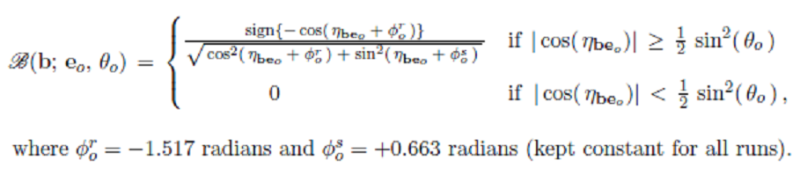
- Joy Christian
- Research Physicist
- Posts: 2793
- Joined: Wed Feb 05, 2014 4:49 am
- Location: Oxford, United Kingdom
Re: A simple two-page proof of local realism
by gill1109 » Thu Feb 20, 2014 4:25 am
What do you mean, precisely (mathematically), by the orthogonality of C_a and C_b?
Now that the R version of this computation is up and running, the numerical accuracy and the speed can be improved, and this is going to tell us that we do not *exactly* recover the cosine, but only up to some fairly close approximation. Of course, we can try to "juggle" these two "constants" to get the approximation better. But we need to see a mathematical proof that there exists a pair of values which does the job *exactly*.
- gill1109
- Mathematical Statistician
- Posts: 2812
- Joined: Tue Feb 04, 2014 10:39 pm
- Location: Leiden
Re: A simple two-page proof of local realism
by Joy Christian » Thu Feb 20, 2014 4:44 am
gill1109 wrote:OK, so where is the derivation that phi(o, r) = -1.517... and phi(o, s) = 0.663 ... does the job, and what are the analytic expressions for these two angles? These numbers which come out of a hat remind me of Einstein's cosmological constant.
What do you mean, precisely (mathematically), by the orthogonality of C_a and C_b?
Now that the R version of this computation is up and running, the numerical accuracy and the speed can be improved, and this is going to tell us that we do not *exactly* recover the cosine, but only up to some fairly close approximation. Of course, we can try to "juggle" these two "constants" to get the approximation better. But we need to see a mathematical proof that there exists a pair of values which does the job *exactly*.
I do not have either a derivation or analytical expressions for the two phase angles. They have been fine-tuned to make the curve fit the cosine curve. I am flattered that you would compare them with Einstein's cosmological constant---one of the most insightful blunders he ever made (cf. dark energy and accelerating universe).
By the way, I am working on your S^2 code to do the same kind of fine-tuning (as shown in the image above), and now the curves match exactly. More on this soon.
By orthogonally of C_a and C_b I mean the following in Chantal's code (this is the version I have on my computer---note the shift from cos to sin in C_b):
double C_a1 = Math.cos(eta_ae + phi_op)/N_a; // ordinary channel; lambda = +1
double C_a2 = Math.cos(eta_ae + phi_op + Math.PI)/N_a; // ordinary channel; lambda = -1
double C_b1 = Math.sin(eta_be + phi_or)/N_b; // extraordinary channel; lambda = +1
double C_b2 = Math.sin(eta_be + phi_or + Math.PI)/N_b; // extraordinary channel; lambda = -1
- Joy Christian
- Research Physicist
- Posts: 2793
- Joined: Wed Feb 05, 2014 4:49 am
- Location: Oxford, United Kingdom
Re: A simple two-page proof of local realism
by gill1109 » Thu Feb 20, 2014 5:09 am
We do *not* have perfect (anti-)correlation at equal settings.
(My "A" is flipped with respect to Chantal's).
The observed correlation was 0.9801263
Joy Christian wrote:By orthogonality of C_a and C_b I mean the following in Chantal's code (this is the version I have on my computer---note the shift from cos to sin in C_b):
double C_a1 = Math.cos(eta_ae + phi_op)/N_a; // ordinary channel; lambda = +1
double C_a2 = Math.cos(eta_ae + phi_op + Math.PI)/N_a; // ordinary channel; lambda = -1
double C_b1 = Math.sin(eta_be + phi_or)/N_b; // extraordinary channel; lambda = +1
double C_b2 = Math.sin(eta_be + phi_or + Math.PI)/N_b; // extraordinary channel; lambda = -1
It looks like Ca2 = - Ca1 and Cb2 = - Cb1, and then we need only talk about Ca1 and Cb1, we could denote them Ca and Cb for short.
Or there is a typo here: the second "op" should be "oq" and the second "or" should be "os"?
In that case we have four functions Ca1, Ca2, Ba1, Ba2. They depend on a, b, e and the phase shifts. For given a and b, one might try to arrange the phase shifts so that some integrals of products equal zero (integrating with respect to the uniform measure of e over S^2).
What is supposed to be orthogonal, in what sense, to what?
Do you want this orthogonality (as functions of e) to hold for all a and b?
- gill1109
- Mathematical Statistician
- Posts: 2812
- Joined: Tue Feb 04, 2014 10:39 pm
- Location: Leiden
Re: A simple two-page proof of local realism
by Joy Christian » Thu Feb 20, 2014 5:55 am
gill1109 wrote:It looks like Ca2 = - Ca1 and Cb2 = - Cb1, and then we need only talk about Ca1 and Cb1, we could denote them Ca and Cb for short.
Yes, that is correct.
gill1109 wrote:Or there is a typo here: the second "op" should be "oq" and the second "or" should be "os"?
There is no typo.
gill1109 wrote:What is supposed to be orthogonal, in what sense, to what?
Do you want this orthogonality (as functions of e) to hold for all a and b?
C_a and C_b are orthogonal to each other in the same sense as cosine and sine functions are orthogonal to each other. They are phase-shifted by 90 degrees.
The "orthogonally" holds for all a and b since the phase angles are constants of the experiment (they are what Bell used to call non-hidden common causes).
- Joy Christian
- Research Physicist
- Posts: 2793
- Joined: Wed Feb 05, 2014 4:49 am
- Location: Oxford, United Kingdom
Re: A simple two-page proof of local realism
by gill1109 » Thu Feb 20, 2014 7:18 am
Joy Christian wrote:gill1109 wrote:It looks like Ca2 = - Ca1 and Cb2 = - Cb1, and then we need only talk about Ca1 and Cb1, we could denote them Ca and Cb for short.
Yes, that is correct.gill1109 wrote:Or there is a typo here: the second "op" should be "oq" and the second "or" should be "os"?
There is no typo.gill1109 wrote:What is supposed to be orthogonal, in what sense, to what?
Do you want this orthogonality (as functions of e) to hold for all a and b?
C_a and C_b are orthogonal to each other in the same sense as cosine and sine functions are orthogonal to each other. They are phase-shifted by 90 degrees.
The "orthogonally" holds for all a and b since the phase angles are constants of the experiment (they are what Bell used to call non-hidden common causes).
For given a and b, Ca and Cb are functions of e, an element of S^2. Do you mean orthogonal with respect to Haar measure on S^2, for each a, b?
- gill1109
- Mathematical Statistician
- Posts: 2812
- Joined: Tue Feb 04, 2014 10:39 pm
- Location: Leiden
Re: A simple two-page proof of local realism
by gill1109 » Thu Feb 20, 2014 7:20 am
I ran the simulation with 1 million runs and confirmed something which is already visible at 10 thousand:
We do *not* have perfect (anti-)correlation at equal settings.
(My "A" is flipped with respect to Chantal's).
The observed correlation was 0.9801263
- gill1109
- Mathematical Statistician
- Posts: 2812
- Joined: Tue Feb 04, 2014 10:39 pm
- Location: Leiden
Re: A simple two-page proof of local realism
by Joy Christian » Thu Feb 20, 2014 7:33 am
gill1109 wrote:For given a and b, Ca and Cb are functions of e, an element of S^2. Do you mean orthogonal with respect to Haar measure on S^2, for each a, b?
No, nothing as sophisticated as that is needed. All I am saying is that when Alice detects a particle, the phase angles ensure that Bob does not end up detecting the same particle. It is a very simple criterion. I later learned from Ben that the same criterion is also used by De Raedt in his work.
- Joy Christian
- Research Physicist
- Posts: 2793
- Joined: Wed Feb 05, 2014 4:49 am
- Location: Oxford, United Kingdom
Re: A simple two-page proof of local realism
by Joy Christian » Thu Feb 20, 2014 7:46 am
gill1109 wrote:PS. Joy, are you going to discuss the failure of the perfect anti-correlation property?
My analytical model predicts perfect anti-correlation.
- Joy Christian
- Research Physicist
- Posts: 2793
- Joined: Wed Feb 05, 2014 4:49 am
- Location: Oxford, United Kingdom
Re: A simple two-page proof of local realism
by gill1109 » Thu Feb 20, 2014 7:47 am
Joy Christian wrote:gill1109 wrote:For given a and b, Ca and Cb are functions of e, an element of S^2. Do you mean orthogonal with respect to Haar measure on S^2, for each a, b?
No, nothing as sophisticated as that is needed. All I am saying is that when Alice detects a particle, the phase angles ensure that Bob does not end up detecting the same particle. It is a very simple criterion. I later learned from Ben that the same criterion is also used by De Raedt in his work.
Please express this in mathematical terms. Or in terms of (a) programming language.
- gill1109
- Mathematical Statistician
- Posts: 2812
- Joined: Tue Feb 04, 2014 10:39 pm
- Location: Leiden
Return to Sci.Physics.Foundations
Who is online
Users browsing this forum: ahrefs [Bot] and 142 guests