A real EPR-Bohm scenario

Foundations of physics and/or philosophy of physics, and in particular, posts on unresolved or controversial issues

Re: A real EPR-Bohm scenario

Postby FrediFizzx » Thu Dec 01, 2016 5:30 pm

Joy Christian wrote:
FrediFizzx wrote:
Joy Christian wrote:The GA model predicts the individual +/-1 also. ***


Hmm... I don't think so as the effect of the polarizers is not included, IIRC. I will have to look at the simulation again.

But it doesn't have to predict the individual event by event outcomes to be completely local-realistic is the new point I am making.

I am not talking about the GA simulation. I am talking about the actual model. What is wrong with the predictions made in eqs. (54) and (55) of this paper:

https://arxiv.org/abs/1405.2355 ?

Eqs. (54) and (55) quite clearly predict individual outcomes: A(a, lambda) = +/-1 and B(b, lambda) = +/-1.

***

That is not event by event outcomes. And what you have now predicts that the outcome for A will be +1 if lambda^k = +1, etc. That does not happen when the effects of the polarizers are included.
.
FrediFizzx
Independent Physics Researcher
 
Posts: 2905
Joined: Tue Mar 19, 2013 7:12 pm
Location: N. California, USA

Re: A real EPR-Bohm scenario

Postby Joy Christian » Thu Dec 01, 2016 5:47 pm

FrediFizzx wrote:
Joy Christian wrote:
FrediFizzx wrote:
Joy Christian wrote:The GA model predicts the individual +/-1 also. ***


Hmm... I don't think so as the effect of the polarizers is not included, IIRC. I will have to look at the simulation again.

But it doesn't have to predict the individual event by event outcomes to be completely local-realistic is the new point I am making.

I am not talking about the GA simulation. I am talking about the actual model. What is wrong with the predictions made in eqs. (54) and (55) of this paper:

https://arxiv.org/abs/1405.2355 ?

Eqs. (54) and (55) quite clearly predict individual outcomes: A(a, lambda) = +/-1 and B(b, lambda) = +/-1.

***

That is not event by event outcomes. And what you have now predicts that the outcome for A will be +1 if lambda^k = +1, etc. That does not happen when the effects of the polarizers are included.
.

GA model produces E(a, b) = -a.b because of a twist in the Hopf bundle, not because of the effects of polarizers included in A and B: viewtopic.php?f=6&t=286#p6893.

For the event-by-event simulation you have to use the "compete state" representation of the 3-sphere model, like this: http://rpubs.com/jjc/84238.

***
Joy Christian
Research Physicist
 
Posts: 2793
Joined: Wed Feb 05, 2014 4:49 am
Location: Oxford, United Kingdom

Re: A real EPR-Bohm scenario

Postby FrediFizzx » Thu Dec 01, 2016 6:29 pm

Joy Christian wrote:GA model produces E(a, b) = -a.b because of a twist in the Hopf bundle, not because of the effects of polarizers included in A and B: viewtopic.php?f=6&t=286#p6893.

For the event-by-event simulation you have to use the "compete state" representation of the 3-sphere model, like this: http://rpubs.com/jjc/84238.

***

That is correct. The polarizers have no effect on the anti-correlation prediction of -a.b. The polarizers only have an effect for trying to predict individual event by event outcomes. And this is exactly why Bell's theory is a pile of smelly stuff. :D Because it is impossible for B + B' to ever be any kind of an element of reality.

I don't think you have the effect of the polarizers built into the "complete state" simulation but I will have to look at it again more carefully.
FrediFizzx
Independent Physics Researcher
 
Posts: 2905
Joined: Tue Mar 19, 2013 7:12 pm
Location: N. California, USA

Re: A real EPR-Bohm scenario

Postby FrediFizzx » Fri Dec 02, 2016 10:32 pm

FrediFizzx wrote:
Joy Christian wrote:GA model produces E(a, b) = -a.b because of a twist in the Hopf bundle, not because of the effects of polarizers included in A and B: viewtopic.php?f=6&t=286#p6893.

For the event-by-event simulation you have to use the "compete state" representation of the 3-sphere model, like this: http://rpubs.com/jjc/84238.

***

That is correct. The polarizers have no effect on the anti-correlation prediction of -a.b. The polarizers only have an effect for trying to predict individual event by event outcomes. And this is exactly why Bell's theory is a pile of smelly stuff. :D Because it is impossible for B + B' to ever be any kind of an element of reality.

I don't think you have the effect of the polarizers built into the "complete state" simulation but I will have to look at it again more carefully.

Well I'll be danged!! :D Complete states does work with the polarizers implemented. I just tried it on my Mathematica version and it works. You should try it in R to verify. Here is the code I used,

Code: Select all

test1[angle_, e_, lambda_ ] := Module[{c, out},
  If[Abs[angle - e] < Pi, d = 1, d = -1];
  c = Cos[d*angle];
  If[lambda >= Abs[c], out = 0, out = Sign[c]];
  out]
test2[angle_, e_, lambda_ ] := Module[{c, out},
  If[Abs[angle - e] < Pi, d = 1, d = -1];
  c = -Cos[d*angle];
  If[lambda >= Abs[c], out = 0, out = Sign[c]];
  out]


So I guess this can make event by event predictions if we know the original polarization angle "e".
.
FrediFizzx
Independent Physics Researcher
 
Posts: 2905
Joined: Tue Mar 19, 2013 7:12 pm
Location: N. California, USA

Re: A real EPR-Bohm scenario

Postby FrediFizzx » Sat Dec 03, 2016 1:20 am

So I think this means that the GA S^3 model can predict the outcomes with the polarizers implemented.

If |a - s| < pi, then +a for up, otherwise -a for down

If ||b -(s+pi)| < pi, then +b for up, otherwise -b for down

Then just do the calculation with lambda included for A and B and there you have it! Full prediction power and no more A = lambda and B = -lambda.
.
FrediFizzx
Independent Physics Researcher
 
Posts: 2905
Joined: Tue Mar 19, 2013 7:12 pm
Location: N. California, USA

Re: A real EPR-Bohm scenario

Postby Joy Christian » Sat Dec 03, 2016 7:07 am

FrediFizzx wrote:So I think this means that the GA S^3 model can predict the outcomes with the polarizers implemented.

If |a - s| < pi, then +a for up, otherwise -a for down

If |b -(s+pi)| < pi, then +b for up, otherwise -b for down

Then just do the calculation with lambda included for A and B and there you have it! Full prediction power and no more A = lambda and B = -lambda.
.

If so, then Albert Jan and you might be able to make it work. I remain skeptical, however. I will have to see the details to see whether the simulation is still local.

***
Joy Christian
Research Physicist
 
Posts: 2793
Joined: Wed Feb 05, 2014 4:49 am
Location: Oxford, United Kingdom

Re: A real EPR-Bohm scenario

Postby FrediFizzx » Sat Dec 03, 2016 9:12 am

Joy Christian wrote:
FrediFizzx wrote:So I think this means that the GA S^3 model can predict the outcomes with the polarizers implemented.

If |a - s| < pi, then +a for up, otherwise -a for down

If |b -(s+pi)| < pi, then +b for up, otherwise -b for down

Then just do the calculation with lambda included for A and B and there you have it! Full prediction power and no more A = lambda and B = -lambda.
.

If so, then Albert Jan and you might be able to make it work. I remain skeptical, however. I will have to see the details to see whether the simulation is still local.

***

Well it is not going to work event by event in the GA model. The correlation prediction still has to be calculated as you have done already. However, the model then more faithfully follows EPR-Bohm with the polarizers implemented. But it should work in the complete states version event by event.

You need to try it in your R version to verify before going any further. It is basically just two lines of code. Instead of using the angle |a - s|, you use the angle a or -a depending on the "if" statement. Same with b. It is perfectly local and follows your limit math better as s1 --> +/- a and s2 --> +/- b. s1 --> (a - s1) is technically not correct.
.
FrediFizzx
Independent Physics Researcher
 
Posts: 2905
Joined: Tue Mar 19, 2013 7:12 pm
Location: N. California, USA

Re: A real EPR-Bohm scenario

Postby Joy Christian » Sat Dec 03, 2016 10:11 am

FrediFizzx wrote:
Joy Christian wrote:
FrediFizzx wrote:So I think this means that the GA S^3 model can predict the outcomes with the polarizers implemented.

If |a - s| < pi, then +a for up, otherwise -a for down

If |b -(s+pi)| < pi, then +b for up, otherwise -b for down

Then just do the calculation with lambda included for A and B and there you have it! Full prediction power and no more A = lambda and B = -lambda.
.

If so, then Albert Jan and you might be able to make it work. I remain skeptical, however. I will have to see the details to see whether the simulation is still local.

***

Well it is not going to work event by event in the GA model. The correlation prediction still has to be calculated as you have done already. However, the model then more faithfully follows EPR-Bohm with the polarizers implemented. But it should work in the complete states version event by event.

You need to try it in your R version to verify before going any further. It is basically just two lines of code. Instead of using the angle |a - s|, you use the angle a or -a depending on the "if" statement. Same with b. It is perfectly local and follows your limit math better as s1 --> +/- a and s2 --> +/- b. s1 --> (a - s1) is technically not correct.
.

Haven't we discussed your last point already? viewtopic.php?f=6&t=271&start=40#p6884

***
Joy Christian
Research Physicist
 
Posts: 2793
Joined: Wed Feb 05, 2014 4:49 am
Location: Oxford, United Kingdom

Re: A real EPR-Bohm scenario

Postby FrediFizzx » Sat Dec 03, 2016 10:21 am

Joy Christian wrote:Haven't we discussed your last point already? viewtopic.php?f=6&t=271&start=40#p6884

***

Yes. There is no problem with that as the limits disappear in the correlation calculation prediction. As they should. As I said, the polarizers don't affect the correlation calculation. But now you are generating the correct spin up +1 or spin down -1 at the detectors. That is the way EPR-Bohm works. Any model should follow it. Bell's model does not follow it.
.
FrediFizzx
Independent Physics Researcher
 
Posts: 2905
Joined: Tue Mar 19, 2013 7:12 pm
Location: N. California, USA

Re: A real EPR-Bohm scenario

Postby Joy Christian » Sat Dec 03, 2016 10:27 am

FrediFizzx wrote:
Joy Christian wrote:Haven't we discussed your last point already? viewtopic.php?f=6&t=271&start=40#p6884

***

Yes. There is no problem with that as the limits disappear in the correlation calculation prediction. As they should. As I said, the polarizers don't affect the correlation calculation. But now you are generating the correct spin up +1 or spin down -1 at the detectors. That is the way EPR-Bohm works. Any model should follow it. Bell's model does not follow it.
.

Not quite following you. Bell's model is not supposed to reproduce all experimental details. All one needs are two math functions A(a, h) = +/-1 and B(b, h) = +/-1.

***
Joy Christian
Research Physicist
 
Posts: 2793
Joined: Wed Feb 05, 2014 4:49 am
Location: Oxford, United Kingdom

Re: A real EPR-Bohm scenario

Postby FrediFizzx » Sat Dec 03, 2016 11:14 am

Joy Christian wrote:
FrediFizzx wrote:
Joy Christian wrote:Haven't we discussed your last point already? viewtopic.php?f=6&t=271&start=40#p6884

***

Yes. There is no problem with that as the limits disappear in the correlation calculation prediction. As they should. As I said, the polarizers don't affect the correlation calculation. But now you are generating the correct spin up +1 or spin down -1 at the detectors. That is the way EPR-Bohm works. Any model should follow it. Bell's model does not follow it.
.

Not quite following you. Bell's model is not supposed to reproduce all experimental details. All one needs are two math functions A(a, h) = +/-1 and B(b, h) = +/-1.

***

And that is where Bell screwed up. By not making it more restrictive to follow EPR-Bohm. That allows in Bell-CHSH to have B + B' be an element of reality when it isn't. It is because due to the action of the polarizers, A, A', B, and B' can only be elements of reality when they are measured in his model. Now, if implementing the polarizers in your R simulation works, then that changes things. I'm not sure exactly how yet.
.
FrediFizzx
Independent Physics Researcher
 
Posts: 2905
Joined: Tue Mar 19, 2013 7:12 pm
Location: N. California, USA

Re: A real EPR-Bohm scenario

Postby FrediFizzx » Sun Dec 04, 2016 6:27 pm

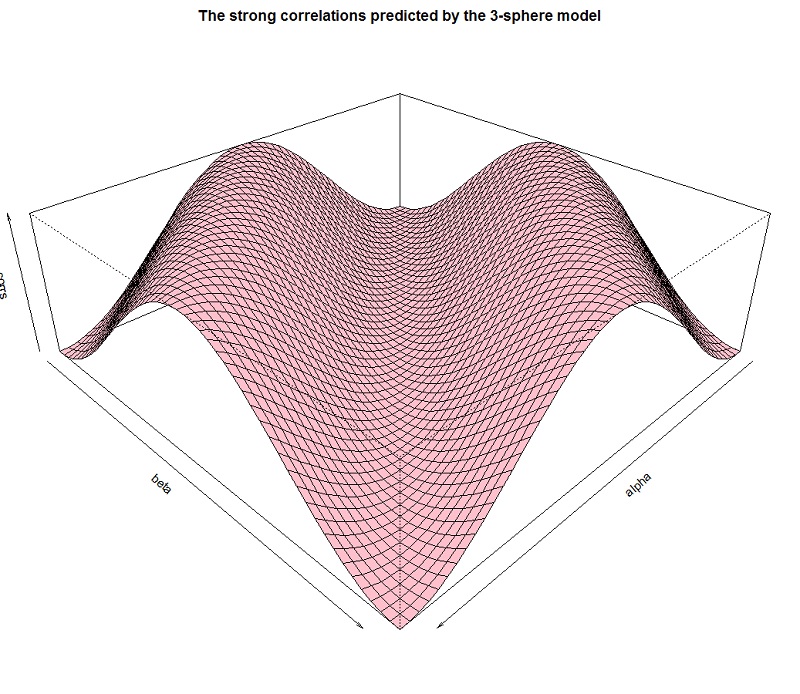
Here is the R code with the polarizers implemented.

Code: Select all
Angles = seq(from = 0, to = 360, by = 7.2) * 2 * pi/360

K = length(Angles) # The total number of angles between 0 and 2pi

corrs = matrix(nrow = K, ncol = K, data = 0) # Container for correlations

#Ns  = matrix(nrow = K, ncol = K, data = 0) # Container for events A and B

#Js  = matrix(nrow = K, ncol = K, data = 0) # Container for "zero" events

#Ls  = matrix(nrow = K, ncol = K, data = 0) # Container for initial states

M = 10^5 # Size of the pre-ensemble. Next one can try 10^5, or even 10^6

r = runif(M, 0, 2*pi) # M uniformly distributed numbers between 0 and 2pi

z = runif(M, -1, +1) # M uniformly distributed numbers between -1 and +1

h = sqrt(1 - z^2)

x = h * cos(r)

y = h * sin(r)

e1 = rbind(x, y, z)
e2 = -e1

s = runif(M, 0, pi) # Initial states of the spins are the pairs (e, s) within S^3

f = -1 + (2/sqrt(1 + ((3 * s)/pi))) # For details see the paper arXiv:1405.2355

g = function(u,v,s){ifelse(abs(colSums(u*v)) > f, cos(Angles), 0)}

d = function(o,t){ifelse(2*acos(colSums(o*t)) < pi, 1, -1)}

for (i in 1:K) {
  # i = 5
  alpha = Angles[i]
  a = c(cos(alpha), sin(alpha), 0)  # Measurement direction 'a'
 
  for (j in 1:K) {
    # j = 23   
    beta = Angles[j]
    b = c(cos(beta), sin(beta), 0)  # Measurement direction 'b'
    C = (g(a,e1,s))
    A = sign(d(a,e1)*C)  # Alice's measurement results A(a, e, s) = +/-1
    D = (g(b,e2,s))
    B = sign(d(b,e2)*D)  # Bob's measurement results B(b, e, s) = -/+1
   
    N = length((A*B)[A & B]) # Number of all possible events observed in S^3
   
    corrs[i,j] = sum(A*B)/N  # Product moment correlation coefficient E(a, b)
   
  }
}

par(mar = c(0, 0, 2, 0))
persp(x = Angles, y = Angles, main = "The strong correlations predicted by the 3-sphere model", z = corrs, zlim = c(-1, 1), col = "pink", theta = 135, phi = 30, scale = FALSE, xlab = "alpha", ylab = "beta")


This follows Joy's GA math better since we only use the "Angles" times the if statement for the polarizers (+1 or -1) for outcomes at A and B. The old way had the A and B outcomes dependent on the dot product between a and e, cos(a - e) and b and e, cos(b - e). This way doesn't. However, A and B outcomes still also depend on the complete states which is a function of (Angles - e). And the result is,

Image
.
FrediFizzx
Independent Physics Researcher
 
Posts: 2905
Joined: Tue Mar 19, 2013 7:12 pm
Location: N. California, USA

Re: A real EPR-Bohm scenario

Postby FrediFizzx » Sun Dec 04, 2016 8:43 pm

So here we have a S^3 local model that given the hidden variable, etc., we could in effect predict Michel's "possibilities" for A, B, A' and B' for each individual event even with the polarizers implemented. So the model is also realistic. But it is easy to see that we could not have "actualities" for A and A' nor B and B' per event.

Now as for the polarizers, all we need to know is the hidden variable, the polarizer (detector) angle, and the original creation polarization angle in order to predict what an outcome at A or B is event by event. The polarizers do not present an extra hidden variable as their function is fixed. So I was wrong before when I said that no theory could predict the outcomes due to the action of the polarizers. This model certainly can.
FrediFizzx
Independent Physics Researcher
 
Posts: 2905
Joined: Tue Mar 19, 2013 7:12 pm
Location: N. California, USA

Re: A real EPR-Bohm scenario

Postby FrediFizzx » Sun Dec 04, 2016 11:01 pm

Now in the R EPRB simulation above, a and b are fixed at 7.2 degree increments. But it works just as well in my Mathematica simulation where a and b aren't fixed and are random. A PDF file of the Mathematica simulation can be found here.

EPRsims/EPRsim_MF_JR_JC_polarizers.pdf
FrediFizzx
Independent Physics Researcher
 
Posts: 2905
Joined: Tue Mar 19, 2013 7:12 pm
Location: N. California, USA

Re: A real EPR-Bohm scenario

Postby Joy Christian » Mon Dec 05, 2016 3:16 am

FrediFizzx wrote:
Here is the R code with the polarizers implemented.

This follows Joy's GA math better since we only use the "Angles" times the if statement for the polarizers (+1 or -1) for outcomes at A and B. The old way had the A and B outcomes dependent on the dot product between a and e, cos(a - e) and b and e, cos(b - e). This way doesn't. However, A and B outcomes still also depend on the complete states which is a function of (Angles - e).

Fred, in your R code I changed the sign in e2 = -e1 to plus, writing e2 = e1, and I also changed the sign in the correlation sum from "sum" to "-sum", which produces exactly the same plot. So the polarizers do not seem to be doing anything special, apart from flipping the plot upside down (which is statistically the same plot).

***
Joy Christian
Research Physicist
 
Posts: 2793
Joined: Wed Feb 05, 2014 4:49 am
Location: Oxford, United Kingdom

Re: A real EPR-Bohm scenario

Postby FrediFizzx » Mon Dec 05, 2016 10:03 am

Joy Christian wrote:
FrediFizzx wrote:
Here is the R code with the polarizers implemented.

This follows Joy's GA math better since we only use the "Angles" times the if statement for the polarizers (+1 or -1) for outcomes at A and B. The old way had the A and B outcomes dependent on the dot product between a and e, cos(a - e) and b and e, cos(b - e). This way doesn't. However, A and B outcomes still also depend on the complete states which is a function of (Angles - e).

Fred, in your R code I changed the sign in e2 = -e1 to plus, writing e2 = e1, and I also changed the sign in the correlation sum from "sum" to "-sum", which produces exactly the same plot. So the polarizers do not seem to be doing anything special, apart from flipping the plot upside down (which is statistically the same plot).

***

Hi Joy,

That doesn't do anything with regard to the polarizers. You can leave that part of the code as you had it. I was just putting it more like it should be as particle 2 is e1 plus pi which is the same as e2 = -e1. You taught me that. Change the -1 to +1 in the polarizer code and see what happens. IOW, so both the else's on the if statement are both +1 thus taking the polarizer out.

The big new thing here is that we are using a and b instead of using an angle (a - e), etc. for getting the outcomes at A and B. (a - e) and (b - e) only affect complete state selection and polarizer action. It follows your GA math better this way.
.
FrediFizzx
Independent Physics Researcher
 
Posts: 2905
Joined: Tue Mar 19, 2013 7:12 pm
Location: N. California, USA

Re: A real EPR-Bohm scenario

Postby Joy Christian » Mon Dec 05, 2016 10:14 am

FrediFizzx wrote:Hi Joy,

That doesn't do anything with regard to the polarizers. You can leave that part of the code as you had it. I was just putting it more like it should be as particle 2 is e1 plus pi which is the same as e2 = -e1. You taught me that. Change the -1 to +1 in the polarizer code and see what happens. IOW, so both the else's on the if statement are both +1 thus taking the polarizer out.

The big new thing here is that we are using a and b instead of using an angle (a - e), etc. for getting the outcomes at A and B. (a - e) and (b - e) only affect complete state selection and polarizer action. It follows your GA math better this way.
.

I am still struggling with this. Where does the GA math fit into the R code, which is about the "complete state" version of the S^3 model? It has nothing to do with GA.

***
Joy Christian
Research Physicist
 
Posts: 2793
Joined: Wed Feb 05, 2014 4:49 am
Location: Oxford, United Kingdom

Re: A real EPR-Bohm scenario

Postby FrediFizzx » Mon Dec 05, 2016 10:42 am

Joy Christian wrote:
FrediFizzx wrote:Hi Joy,

That doesn't do anything with regard to the polarizers. You can leave that part of the code as you had it. I was just putting it more like it should be as particle 2 is e1 plus pi which is the same as e2 = -e1. You taught me that. Change the -1 to +1 in the polarizer code and see what happens. IOW, so both the else's on the if statement are both +1 thus taking the polarizer out.

The big new thing here is that we are using a and b instead of using an angle (a - e), etc. for getting the outcomes at A and B. (a - e) and (b - e) only affect complete state selection and polarizer action. It follows your GA math better this way.
.

I am still struggling with this. Where does the GA math fit into the R code, which is about the "complete state" version of the S^3 model? It has nothing to do with GA.

***


In eqs. (54) and (55) you have s1 --> a and s2 --> b, not s1 --> (a - s1) and not s2 --> (b - s2). Of course with the polarizers implemented, it is s1 --> +/- a and s2 --> +/- b. Which is essentially what you have in eq. (60). The ese's are being toggled by lambda so what you end up with is

sign(+/- a.a) and -sign(+/-b.b).

But that is not exactly right. They should be toggled by (a - s1) < pi and (b - s2) < pi instead of just lambda.
.
FrediFizzx
Independent Physics Researcher
 
Posts: 2905
Joined: Tue Mar 19, 2013 7:12 pm
Location: N. California, USA

Re: A real EPR-Bohm scenario

Postby FrediFizzx » Mon Dec 05, 2016 11:30 am

Let me try to construct what we have from the new R simulation for complete states simplified a bit.


where d = +1 if (a - e) < pi, -1 otherwise. And C = cos( a) if (a - e) > f, 0 otherwise. Where f is a function of .


where d = +1 if (b - e) < pi, -1 otherwise. And D = cos(b) if (b - e) > f, 0 otherwise. Where f is a function of .

So is only involved in the selection of the complete states and does not toggle the polarizer. So we have,


.
FrediFizzx
Independent Physics Researcher
 
Posts: 2905
Joined: Tue Mar 19, 2013 7:12 pm
Location: N. California, USA

Re: A real EPR-Bohm scenario

Postby FrediFizzx » Mon Dec 05, 2016 12:23 pm

IOW, I have to contend that your eqs. (60) and (64) are not exactly correct.


So according to eq. (59) we have,


Why would we always have the cos(0)?
FrediFizzx
Independent Physics Researcher
 
Posts: 2905
Joined: Tue Mar 19, 2013 7:12 pm
Location: N. California, USA

PreviousNext

Return to Sci.Physics.Foundations

Who is online

Users browsing this forum: No registered users and 81 guests

CodeCogs - An Open Source Scientific Library