minkwe wrote:Richard. What are your answers to the three questions. We can not discuss without them. And please also read this response I gave which talks about random sampling:
viewtopic.php?f=6&t=39&start=20#p1168What do you disagree with in it?
For a mathematician, the word "independent" can mean many different things, but I can't always figure out what you mean when you use the word. But perhaps I can still answer each question even if I would write the introductory sentences in a rather different way.
minkwe wrote:Question 1: Are the three correlations P(a,b), P(a,c), and P(b,c) as they stand in the above inequality independent of each other? Note. I'm not asking if the measurement functions A(a,λ), A(b,λ), A(c,λ) are independent, What I'm asking is this: If you take three independent measurement functions A(a,λ), A(b,λ), A(c,λ) and recombine them in pairs, [A(a,λ)A(b,λ)], [A(a,λ)A(c,λ)], [A(b,λ)A(c,λ)] as was done during the derivation (factorization steps). Are these pairs independent of each other?
There are two questions here, not one question. The proof shows that there are relations between P(a,b), P(a,c), and P(b,c). The proof uses relations between [A(a,λ)A(b,λ)], [A(a,λ)A(c,λ)] and [A(b,λ)A(c,λ)]. In particular, the product of all three products is identically equal to +1. So the only possible values of the three products are (+1, +1, +1), (+1, -1, -1), (-1, +1, -1), and (-1, -1, +1). Knowing two of the three products actually fixes the third. The proof uses this fact, to show that knowing two of the correlations puts restrictions on the third.
I wouldn't use the word "independent" but all the same, I think I understand what you mean, so I would answer both questions with "no".
minkwe wrote:Question 2: Are the four correlations E(a,b), E(a,b'), E(a',b') and E(a',b) as they stand in the above inequality independent of each other? Note. I'm not asking if the four measurement functions A(a,λ), B(b,λ), A(a',λ), B(b',λ) are independent, What I'm asking is this: If you take four independent measurement functionsA(a,λ), B(b,λ), A(a',λ), B(b',λ) and recombine them in pairs, [A(a,λ)B(b,λ)], [A(a,λ)B(b',λ)], [A(a',λ)B(b',λ)], [A(a',λ)B(b,λ)] as was done during the derivation (factorization steps). Are these pairs independent of each other?
Same remarks, same answers, to the two questions you ask here, not one question. Now we look at four products and four correlations. The product of all four products is identically equal to +1 so the four products cannot take on arbitrary values. Knowing three of them determines the first. The proof uses this relationship in order to derive a relationship between the four correlations. Knowing three of them limits the possible values of the fourth.
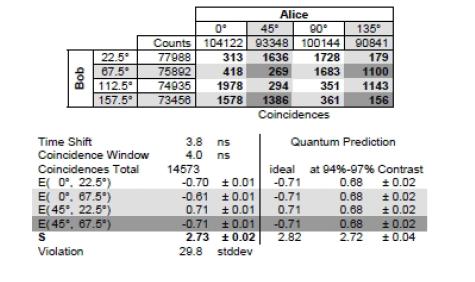
minkwe wrote:Question 3: Are the four correlations E1(a,b), E2(a,b'), E3(a',b') and E4(a',b) from real experiments, each measured on different set of particles from the other dependent on each other in the same way as those in the Bell and CHSH inequalities?
Answer: no. Obviously not. There are no limits at all on their values. If E1 is based on N1 observations then it could take any value between -1 and +1 in steps of 2/(N1 + 1) because the #equal could be 0, 1, 2, ... N1, and the correlation equals twice #equal / N1 minus 1. And at the same time the other three correlations can be anything allowed by the relevant sample sizes N2, N3, N4, in just the same way. Knowing any three of the correlations puts no restrictions on the fourth.
So I agree with you all the way here (except perhaps in your wording). And everything you say here, I have known for as long as I have known Bell's inequality. I use exactly the same facts in my own work. All of them.
I'll answer the other question in a separate post.