Bell & CHSH type inequalities and experiments

Foundations of physics and/or philosophy of physics, and in particular, posts on unresolved or controversial issues

Re: Bell & CHSH type inequalities and experiments

Postby minkwe » Fri Apr 04, 2014 8:54 am

Heinera wrote:But it is. Given some large N, you are suggesting that restricting the correlation computation on N pairs of numbers to an N/4 random subset of those pairs somehow gives you a significantly different correlation, are you not?

No. I'm saying the relationship between two correlated variables from the exact same set should not be expected to hold between to two variables from completely disjoint sets. You are getting confused by Richard's N and missed the point in this statement:

minkwe wrote:The height of the 250000 people is not a independent free variable from the weight of the same 250000 people. However, the height of the 250000 people is an independent free variable from the weight of another 250000 completely different people drawn from the same population.


Do you expect outcomes from one set of particle pairs to be correlated with outcomes from a completely different set of particle pairs? If you measure them all on the same set, you would expect correlations between them. If you measure them on different sets you shouldn't, even if you are measuring the same type of properties at the same angles. It is that simple.

If you measure E(a,b), E(a,b'), E(a',b') and E(a',b) all from a single set of particle pairs, you would expect those expectation values to be correlated. If you measure them each from a different set of particle pairs, you shouldn't expect the same correlations between them to be present. It is that simple.
minkwe
 
Posts: 1441
Joined: Sat Feb 08, 2014 10:22 am

Re: Bell & CHSH type inequalities and experiments

Postby Heinera » Fri Apr 04, 2014 9:22 am

minkwe wrote:
Heinera wrote:But it is. Given some large N, you are suggesting that restricting the correlation computation on N pairs of numbers to an N/4 random subset of those pairs somehow gives you a significantly different correlation, are you not?

No.


So, given some large N, restricting the correlation computation on N pairs of numbers to an N/4 random subset of those pairs gives you (approximately) the same correlation? (I just want to ensure that we agree on this point).
Heinera
 
Posts: 917
Joined: Thu Feb 06, 2014 1:50 am

Re: Bell & CHSH type inequalities and experiments

Postby minkwe » Fri Apr 04, 2014 10:04 am

Heinera wrote:So, given some large N, restricting the correlation computation on N pairs of numbers to an N/4 random subset of those pairs gives you (approximately) the same correlation? (I just want to ensure that we agree on this point).

What relevance does this have to what I'm talking about? It is irrelevant to what I'm saying and too vague to agree or disagree with. You have to be specific what correlations you are talking about and what you mean by random as far as those specific correlations are concerned. Besides, there are 4 correlations involved (or 3 if you prefer Bell's set-up), so you can't just talk about one and forget the others.

I have already explained very clearly that if you measure A(a,λ), B(b,λ), A(a',λ), B(b',λ) on one set of particles, and use those 4 data streams to calculate 4 paired correlations E(a,b), E(a,b'), E(a',b') and E(a',b), you will not get the same results as if you measure 8 data streams (4-pairs) , A1(a), B1(b), A2(a), B2(b'), A3(a'), B3(b), A4(a'), B4(b') separate sets of particles and use them to calculate 4 paired correlations E1(a,b), E2(a,b'), E3(a',b') and E4(a',b) with each pair contributing to only one paired correlation. Some of the values will be the same, but not all of them. What part of this is still not clear?

Another way to look at it: Say you randomly measure E(a,b), (that is A(a,λ), B(b,λ)). To calculate the other correlations from the same set of particles you now have, means the rest of the correlations are not based on random measurements any more. This is because when calculating E(a,b'), you must use the exact same A(a,λ) data stream you recorded for the first correlation, and when calculating E(a',b), you must use the exact same B(b,λ) data stream you recorded for the first correlation and you can follow the chain to conclude that only one of those correlations from a single set of particles can be said to be random samples of any population, the others are definitely not.

However, measuring E1(a,b), E2(a,b'), E3(a',b') and E4(a',b) each from a different set of particles can be done and is in-fact done such that each one is a random sample independent of the others.

This goes to the heart of the degrees of freedom problem I'm illustrating. The issue is not whether a random sample of a population will have the same values as the population, it is that the values all measured from the same set of particles, as required by the CHSH can not all be random samples of a population independent of each other.
minkwe
 
Posts: 1441
Joined: Sat Feb 08, 2014 10:22 am

Re: Bell & CHSH type inequalities and experiments

Postby Heinera » Fri Apr 04, 2014 10:38 am

minkwe wrote:
Heinera wrote:So, given some large N, restricting the correlation computation on N pairs of numbers to an N/4 random subset of those pairs gives you (approximately) the same correlation? (I just want to ensure that we agree on this point).

You have to be specific what correlations you are talking about and what you mean by random as far as those specific correlations are concerned.


I am talking about a list of length N of pairs of numbers. The numbers could be anything. There is a well known formula for computing the correlation for such a list (aka Pearson's correlation). That is the correlation I specify. By random, I mean that I have a binary random variable with the distribution 0.75 for 0, and 0.25 for 1. To generate the subset, I sample this variable for each line in the list of pairs of numbers, and include the pair in the subset if I sample 1. Relevance will hopefully be clear later. Now, with this clarification, do we agree?
Heinera
 
Posts: 917
Joined: Thu Feb 06, 2014 1:50 am

Re: Bell & CHSH type inequalities and experiments

Postby minkwe » Fri Apr 04, 2014 11:51 am

Heinera wrote:
minkwe wrote:
Heinera wrote:So, given some large N, restricting the correlation computation on N pairs of numbers to an N/4 random subset of those pairs gives you (approximately) the same correlation? (I just want to ensure that we agree on this point).

You have to be specific what correlations you are talking about and what you mean by random as far as those specific correlations are concerned.


I am talking about a list of length N of pairs of numbers. The numbers could be anything. There is a well known formula for computing the correlation for such a list (aka Pearson's correlation). That is the correlation I specify. By random, I mean that I have a binary random variable with the distribution 0.75 for 0, and 0.25 for 1. To generate the subset, I sample this variable for each line in the list of pairs of numbers, and include the pair in the subset if I sample 1. Relevance will hopefully be clear later. Now, with this clarification, do we agree?


Did you read all of my previous post? What don't you understand in it? What do you disagree with? Pearson's correlation is completely irrelevant. Pearson's formular is not used in Aspect-type experiments so I don't see why you think it is relevant here. If you have a point or argument to make, make it.
Last edited by minkwe on Fri Apr 04, 2014 12:07 pm, edited 1 time in total.
minkwe
 
Posts: 1441
Joined: Sat Feb 08, 2014 10:22 am

Re: Bell & CHSH type inequalities and experiments

Postby Heinera » Fri Apr 04, 2014 12:04 pm

minkwe wrote:
Heinera wrote:
minkwe wrote:You have to be specific what correlations you are talking about and what you mean by random as far as those specific correlations are concerned.


I am talking about a list of length N of pairs of numbers. The numbers could be anything. There is a well known formula for computing the correlation for such a list (aka Pearson's correlation). That is the correlation I specify. By random, I mean that I have a binary random variable with the distribution 0.75 for 0, and 0.25 for 1. To generate the subset, I sample this variable for each line in the list of pairs of numbers, and include the pair in the subset if I sample 1. Relevance will hopefully be clear later. Now, with this clarification, do we agree?


Did you read all of my previous post? What don't you understand in it? What do you disagree with?

So far I don't disagree with anything. I just asked a simple yes/no question, "So, given some large N, restricting the correlation computation on N pairs of numbers to an N/4 random subset of those pairs gives you (approximately) the same correlation?". You asked for clarification, which I provided. I can't see the question has been answered.
Heinera
 
Posts: 917
Joined: Thu Feb 06, 2014 1:50 am

Re: Bell & CHSH type inequalities and experiments

Postby minkwe » Fri Apr 04, 2014 12:25 pm

Heinera wrote:So far I don't disagree with anything. I just asked a simple yes/no question, "So, given some large N, restricting the correlation computation on N pairs of numbers to an N/4 random subset of those pairs gives you (approximately) the same correlation?"

Assuming you are talking about calculating one correlation between pairs of values from a single random sample of a population, the answer is Yes the values will be almost the same as in the population. Now what is the relevance of this to the point I'm making?
minkwe
 
Posts: 1441
Joined: Sat Feb 08, 2014 10:22 am

Re: Bell & CHSH type inequalities and experiments

Postby Heinera » Fri Apr 04, 2014 1:03 pm

minkwe wrote:
Heinera wrote:So far I don't disagree with anything. I just asked a simple yes/no question, "So, given some large N, restricting the correlation computation on N pairs of numbers to an N/4 random subset of those pairs gives you (approximately) the same correlation?"

Assuming you are talking about calculating one correlation between pairs of values from a single random sample of a population, the answer is Yes the values will be almost the same as in the population. Now what is the relevance of this to the point I'm making?

Good. So let's just assume that Joy's experiment has been performed. I am now presented with a two column list, where the first column is a collection of vectors lambda, with the other column equal to minus lambda. I now pick two angles a and b. For each row in the list, I compute the two outcomes according to Joy's prescription (they will take values among +1 and -1). So now I have a two column array of length N, with values in the set +1 or -1. Now I compute the E(a,b) correlation of these two variables on all the N rows. Then I randomly (according to the description I previously described) select a subset of approximately size N/4. I then compute the correlations again on this subset. Let's call that correlation E'(a,b). I guess you agree that E(a,b) is approximately equal to E'(a,b)? (and sorry, I'm afraid it's yet one more yes/no question).
Heinera
 
Posts: 917
Joined: Thu Feb 06, 2014 1:50 am

Re: Bell & CHSH type inequalities and experiments

Postby minkwe » Fri Apr 04, 2014 4:03 pm

Heinera wrote:
minkwe wrote:
Heinera wrote:So far I don't disagree with anything. I just asked a simple yes/no question, "So, given some large N, restricting the correlation computation on N pairs of numbers to an N/4 random subset of those pairs gives you (approximately) the same correlation?"

Assuming you are talking about calculating one correlation between pairs of values from a single random sample of a population, the answer is Yes the values will be almost the same as in the population. Now what is the relevance of this to the point I'm making?

Good. So let's just assume that Joy's experiment has been performed. I am now presented with a two column list, where the first column is a collection of vectors lambda, with the other column equal to minus lambda. I now pick two angles a and b. For each row in the list, I compute the two outcomes according to Joy's prescription (they will take values among +1 and -1). So now I have a two column array of length N, with values in the set +1 or -1. Now I compute the E(a,b) correlation of these two variables on all the N rows. Then I randomly (according to the description I previously described) select a subset of approximately size N/4. I then compute the correlations again on this subset. Let's call that correlation E'(a,b). I guess you agree that E(a,b) is approximately equal to E'(a,b)? (and sorry, I'm afraid it's yet one more yes/no question).


Yes, if you are doing proper random sampling, E'(a,b) from the population will be almost the same as E'(a,b) from the random sample.
minkwe
 
Posts: 1441
Joined: Sat Feb 08, 2014 10:22 am

Re: Bell & CHSH type inequalities and experiments

Postby FrediFizzx » Fri Apr 04, 2014 7:25 pm

minkwe wrote:The wikipedia derivation is correct. You will have to point me to your favourite derivation and I will use it to show you that it does not escape the point I'm making.

You are right; it is correct on wikipedia because <A(a, lambda)> is not the same as <A(a', lambda)> (IOW, the A's are different). I guess I was getting it mixed up with Richard's version where the A's are the same in <AB> and <AB'>.
FrediFizzx
Independent Physics Researcher
 
Posts: 2905
Joined: Tue Mar 19, 2013 7:12 pm
Location: N. California, USA

Re: Bell & CHSH type inequalities and experiments

Postby gill1109 » Fri Apr 04, 2014 9:00 pm

FrediFizzx wrote:
minkwe wrote:The wikipedia derivation is correct. You will have to point me to your favourite derivation and I will use it to show you that it does not escape the point I'm making.

You are right; it is correct on wikipedia because <A(a, b)> is not the same as <A(a', b)> (IOW, the A's are different). I guess I was getting it mixed up with Richard's version where the A's are the same in <AB> and <AB'>.


Of course my A's are the same in my <AB> and <AB'>. The B's are different.

There are altogether 8 different linear CHSH inequalities.

Take one, e.g. <AB> + <AB'> + <A'B> - <A'B'> <= 2. Exchange A and A', and you get another. Exchange B and B' and you get another. Exchange A for - A and you get another.

To count them another way: look at four correlations: the correlations between A or A', and B or B'. Compare any one of the four, with the sum of three others. Each one is bigger than the sum of the others minus 2, and smaller than the sum of the others plus 2. That's altogether 8 inequalities. A proof of any one, gives you a proof of all eight, since what you call A and A', or B and B', is a matter of indifference. Also you can look at -A or -A' or -B or -B' instead of the original A, A', B, B' respectively. You can even exchange A's for B's.

A whole load of symmetries. Proving just one linear inequality actually gives a proof of eight linear inequalities. In my paper I discuss the local realist polytope, the convex body, and the no-signalling polytope: each a proper subset of the next. In a 2x2x2 experiment there are altogether 16 experimental probabilities Prob(Alice measurement = x, Bob measurement = y | Alice setting = a, Bob setting = b). List them one after another in a vector of length 16. ie, one model whether LHV, QM or beyond, determines one point in R^16. There are linear equalities holding between these probabilities, we call them the normalization constraints. Because of no action at a distance, we have so-called no-signalling constraints: Prob(Alice measurement = x| Alice setting = a, Bob setting = b) = Prob(Alice measurement = x| Alice setting = a, Bob setting = b'). These are also linear when expressed in terms of the 16 experimental probabilities. The normalization and no-signalling constraints put the vector of 16 experimental probabilites in an 8 dimensional affine subspace. Probabilies are non-negative - we have positivity constraints. They put us into an 8 dimensional convex polytope called the no-signalling polytope.

QM puts further constraints on these probabilies (the Tsirelson bound, among others).

LHV puts further constraints on these probabilities still (Bell-CHSH).

Image
Last edited by gill1109 on Fri Apr 04, 2014 9:29 pm, edited 4 times in total.
gill1109
Mathematical Statistician
 
Posts: 2812
Joined: Tue Feb 04, 2014 10:39 pm
Location: Leiden

Re: Bell & CHSH type inequalities and experiments

Postby gill1109 » Fri Apr 04, 2014 9:12 pm

minkwe wrote:Yes, if you are doing proper random sampling, E'(a,b) from the population will be almost the same as E'(a,b) from the random sample.

Now consider a CHSH-type experiment, and suppose that local hidden variables do exist, so that whether or not we actually observe in directions a and b on any particular run, A(a, lambda) and B(b, lambda) do both exist. After all, a, b and lambda exist (even if lambda is "hidden"), and A and B are just two particular mathematical functions.

We do N runs of the experiment. We get to see A(a, lambda) and B(b, lambda) on about N/4 of those runs, because on each run, we choose at random between settings a and a', and settings b and b'.

A proper random sub-sample of a proper random sample from a population is also a proper random sample from the same population.

The N values of lambda belonging to all N runs are a random sample from the population of all possible values.

The N/4 values of lambda in the sub-sample when measurements are done in directions a and b, are a random sub-sample.

If N is large, the average of A(a, lambda) x B(b, lambda) in the sub-sample (size N/4) and the average of A(a, lambda) x B(b, lambda) in the whole sample (size N) and the average of A(a, lambda) x B(b, lambda) in the population (infinite size) will all three be close to one another.

Agree or disagree?
gill1109
Mathematical Statistician
 
Posts: 2812
Joined: Tue Feb 04, 2014 10:39 pm
Location: Leiden

Re: Bell & CHSH type inequalities and experiments

Postby minkwe » Sat Apr 05, 2014 5:50 am

Richard. What are your answers to the three questions. We can not discuss without them. And please also read this response I gave which talks about random sampling:
viewtopic.php?f=6&t=39&start=20#p1168
What do you disagree with in it?
minkwe
 
Posts: 1441
Joined: Sat Feb 08, 2014 10:22 am

Re: Bell & CHSH type inequalities and experiments

Postby gill1109 » Sat Apr 05, 2014 9:30 am

minkwe wrote:Richard. What are your answers to the three questions. We can not discuss without them. And please also read this response I gave which talks about random sampling:
viewtopic.php?f=6&t=39&start=20#p1168
What do you disagree with in it?


For a mathematician, the word "independent" can mean many different things, but I can't always figure out what you mean when you use the word. But perhaps I can still answer each question even if I would write the introductory sentences in a rather different way.

minkwe wrote:Question 1: Are the three correlations P(a,b), P(a,c), and P(b,c) as they stand in the above inequality independent of each other? Note. I'm not asking if the measurement functions A(a,λ), A(b,λ), A(c,λ) are independent, What I'm asking is this: If you take three independent measurement functions A(a,λ), A(b,λ), A(c,λ) and recombine them in pairs, [A(a,λ)A(b,λ)], [A(a,λ)A(c,λ)], [A(b,λ)A(c,λ)] as was done during the derivation (factorization steps). Are these pairs independent of each other?


There are two questions here, not one question. The proof shows that there are relations between P(a,b), P(a,c), and P(b,c). The proof uses relations between [A(a,λ)A(b,λ)], [A(a,λ)A(c,λ)] and [A(b,λ)A(c,λ)]. In particular, the product of all three products is identically equal to +1. So the only possible values of the three products are (+1, +1, +1), (+1, -1, -1), (-1, +1, -1), and (-1, -1, +1). Knowing two of the three products actually fixes the third. The proof uses this fact, to show that knowing two of the correlations puts restrictions on the third.

I wouldn't use the word "independent" but all the same, I think I understand what you mean, so I would answer both questions with "no".

minkwe wrote:Question 2: Are the four correlations E(a,b), E(a,b'), E(a',b') and E(a',b) as they stand in the above inequality independent of each other? Note. I'm not asking if the four measurement functions A(a,λ), B(b,λ), A(a',λ), B(b',λ) are independent, What I'm asking is this: If you take four independent measurement functionsA(a,λ), B(b,λ), A(a',λ), B(b',λ) and recombine them in pairs, [A(a,λ)B(b,λ)], [A(a,λ)B(b',λ)], [A(a',λ)B(b',λ)], [A(a',λ)B(b,λ)] as was done during the derivation (factorization steps). Are these pairs independent of each other?


Same remarks, same answers, to the two questions you ask here, not one question. Now we look at four products and four correlations. The product of all four products is identically equal to +1 so the four products cannot take on arbitrary values. Knowing three of them determines the first. The proof uses this relationship in order to derive a relationship between the four correlations. Knowing three of them limits the possible values of the fourth.

minkwe wrote:Question 3: Are the four correlations E1(a,b), E2(a,b'), E3(a',b') and E4(a',b) from real experiments, each measured on different set of particles from the other dependent on each other in the same way as those in the Bell and CHSH inequalities?

Answer: no. Obviously not. There are no limits at all on their values. If E1 is based on N1 observations then it could take any value between -1 and +1 in steps of 2/(N1 + 1) because the #equal could be 0, 1, 2, ... N1, and the correlation equals twice #equal / N1 minus 1. And at the same time the other three correlations can be anything allowed by the relevant sample sizes N2, N3, N4, in just the same way. Knowing any three of the correlations puts no restrictions on the fourth.

So I agree with you all the way here (except perhaps in your wording). And everything you say here, I have known for as long as I have known Bell's inequality. I use exactly the same facts in my own work. All of them.

I'll answer the other question in a separate post.
Last edited by gill1109 on Sat Apr 05, 2014 10:30 am, edited 4 times in total.
gill1109
Mathematical Statistician
 
Posts: 2812
Joined: Tue Feb 04, 2014 10:39 pm
Location: Leiden

Re: Bell & CHSH type inequalities and experiments

Postby gill1109 » Sat Apr 05, 2014 9:48 am

minkwe wrote:And please also read this response I gave which talks about random sampling:
viewtopic.php?f=6&t=39&start=20#p1168
What do you disagree with in it?


First attempt at answering (long).

Heinera already spent a long time trying to explain to you why this random sampling stuff is relevant. I agree with all his answers, and he even got you to agree to a rather important question of his own. I was glad to see that. It means we are nearly home.

Nobody here is saying that exactly the same relationship holds between the correlations computed from four disjoint (but each separately, random) subsamples, the correlations computed from the whole sample, and the correlations which we would see based on the complete sample if its size were infinite. Nobody here is responsible for what the physicists have been writing in their papers for the last 50 years. The physicists use sloppy and careless language. Often they say things which taken literally are not true, but fortunately they are close to true, and most people understand the degree of imprecision which needs to be admitted.

Heinera and I are both trying hard to explain to you that they will all three be close to one another, if N is large: the three things here being (1) the correlation based on a random subsample of size about N/4 which we actually get to see, (2) the correlation which we would see if we would compute it on all N, and (3) the correlation which we would see in the second case if N were infinite. My Theorem 1 makes this precise. Actually it only uses the relationship between the N/4 and the N sample averages. I prove that the averages computed on the four subsamples satisfy the CHSH inequality with the upper bound 2 replaced by 2 plus a small error, with probability nearly equal to 1, if N is large enough. Because the average of a random sample of size (approximately) N/4 from a finite population of size N is close to the average of the finite population. I don't even need to go to the limit. That is the innovation in my work. And it came about through discussing Bell's theorem in places like this. I wanted to avoid all the technical nuisance of taking limits as N goes to infinity. And I wanted explicit probability bounds. Not bounds on expectation values which only apply to samples of infinite size.

Depending on how close you want the probability to be to one, and how small an error you wish to tolerate in the upper bound, you can figure out how big N needs to be.

I use this theorem to find out what N will work for me, if I am planning a bet (for some specified amount) with someone about a computer simulation of a local hidden variables model. For instance, I'm willing to risk losing 5000 Euros with probability 1 in a US billion, any day when at the same time I have 999,999,999 chances out of a US billion = 1000 million of winning 5000 Euros.

It's almost certain that I'll win! And if I have such extremely bad luck (1 in a billion) that I lose, at least I won't immediately go broke. If I lose I'm pretty sure I will be able to bet again another day and quickly make up my losses.

The assumption in my theorem is that a local hidden variables model holds. A mathematical description of what is going on, behind the scenes, right? Within that mathematical description one can define what the outcomes of either measurement on both particle would be, independently of which measurements are actually chosen to be performed. As long as measurement choices are made at random, independently of measurement outcomes, I am in business.

Regarding Joy's experiment, you and I agreed that if we follow Joy's formulation of the experiment in his experimental paper, with all correlations based on the same fixed sample of size N, I will certainly win. In his experiment we actually measure the hidden variable. The measurement outcomes are *computed*, not *observed*. Whatever is really going on in those exploding balls, even if quantum things are going on, there is a local hidden variables model for the final outcomes. Joy is actually imposing it on top of the experiment, independently on whether the balls are quantum Bucky balls, or classical ping pong balls.

And the cool thing is that because of this random sampling stuff, I am almost certain to win if the each correlation is based on a random subsample of expected size N/4, as long as N is large enough. I know how large N has to be, for me to be pretty safe. It doesn't matter that the four subsamples are dependent of one another (they are in fact, of course, disjoint and exhaustive). Thanks to Boole's inequality, this doesn't matter. Probability is wonderful!
Last edited by gill1109 on Sat Apr 05, 2014 10:43 am, edited 1 time in total.
gill1109
Mathematical Statistician
 
Posts: 2812
Joined: Tue Feb 04, 2014 10:39 pm
Location: Leiden

Re: Bell & CHSH type inequalities and experiments

Postby gill1109 » Sat Apr 05, 2014 10:42 am

minkwe wrote:And please also read this response I gave which talks about random sampling:
viewtopic.php?f=6&t=39&start=20#p1168
What do you disagree with in it?


Second attempt at answering (short).

Alternative answer: the response you wrote about random sampling is very long and rather complex. Perhaps you can break it down into five of six steps, each with just one yes/no question at the end?

But actually, Heinera already did a good job in explaining why random sampling is relevant to the problems we are interested in.
gill1109
Mathematical Statistician
 
Posts: 2812
Joined: Tue Feb 04, 2014 10:39 pm
Location: Leiden

Re: Bell & CHSH type inequalities and experiments

Postby FrediFizzx » Sat Apr 05, 2014 2:31 pm

gill1109 wrote:Of course my A's are the same in my <AB> and <AB'>. The B's are different.

There are altogether 8 different linear CHSH inequalities.

Take one, e.g. <AB> + <AB'> + <A'B> - <A'B'> <= 2. Exchange A and A', and you get another. Exchange B and B' and you get another. Exchange A for - A and you get another.

LOL! Those aren't CHSH inequalities. If the A in <AB> is the same as the A in <AB'>, etc. then nothing can violate the bound of 2. Not sure why you still don't understand that. ??? And why don't you just formulate CHSH the normal way of E(a, b), etc? I can only suspect obfuscation on your part the way you are doing it.

Anyways, I guess you agree with Michel on his 3 questions. Now, I don't see a problem with the way say the Weihs, et al, experiment did the CHSH violation by using aprox. N/4 for the data of each E(a, b)'s. And I don't see why it is a problem to do that in a simulation also.
FrediFizzx
Independent Physics Researcher
 
Posts: 2905
Joined: Tue Mar 19, 2013 7:12 pm
Location: N. California, USA

Re: Bell & CHSH type inequalities and experiments

Postby FrediFizzx » Sat Apr 05, 2014 3:29 pm

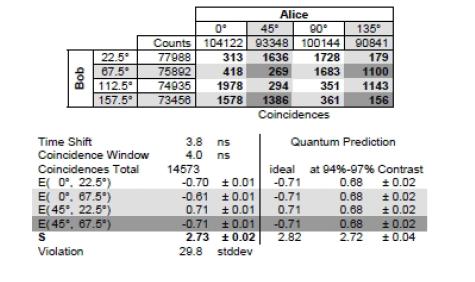
Here is Table 2 from Weihs' paper, "A Test of Bell’s Inequality with Spacelike Separation". I will send to whomever wants it.

TABLE 2. Single and coincidence counts for the four possible events
on each side for a specific dataset. The second and fourth row/column are
obtained when the modulator on the respective side is in state “1”. E(a,b)
is the correlation obtained from the corresponding submatrix. If we call
the whole matrix C, an example will be E(0◦,22.5◦) = [C(0◦,22.5◦)+
C(90◦,112.5◦)−C(90◦,22.5◦)−C(0◦,112.5◦)]/[ΣC]. S is the CHSH expression
S = |E(a,b)−E(a,b)|+E(a,b)+E(a,b)|. The errors quoted
here are only statistical errors due to the limited sample. They do include
any fluctuations in the operating conditions.
Image

"Specific dataset" Now, I don't think they used separate experiments to compose the data for E(a, b), E(a', b), etc. I believe the CHSH violation was done from the same set of particle pairs.
FrediFizzx
Independent Physics Researcher
 
Posts: 2905
Joined: Tue Mar 19, 2013 7:12 pm
Location: N. California, USA

Re: Bell & CHSH type inequalities and experiments

Postby minkwe » Sat Apr 05, 2014 4:14 pm

gill1109 wrote:So I agree with you all the way here (except perhaps in your wording).

Good to see that you finally agree that the terms in the CHSH are related to each other in a way that the terms from experiment are not. Ever heard of mutual dependence?
minkwe
 
Posts: 1441
Joined: Sat Feb 08, 2014 10:22 am

Re: Bell & CHSH type inequalities and experiments

Postby minkwe » Sat Apr 05, 2014 5:10 pm

gill1109 wrote:First attempt at answering (long).

Heinera already spent a long time trying to explain to you why this random sampling stuff is relevant.

I'm still waiting for Heinera's response about relevance, if he has shared that with you, please share it, I haven't seen it yet. All he did was ask me to confirm the obvious fact that a random sample of a population should have almost the same mean as the population. I continue to say it is irrelevant to my point and neither you nor he has demonstrated how random sampling enables you to restore the missing relationship between terms mandated by the CHSH. So I'm sorry your first attempt misses the mark by two miles.

First mile: you say "Nobody here is saying that exactly the same relationship holds between the correlations computed from four disjoint (but each separately, random)". But you surely are, that relationship is embodied in the CHSH inequality. Everytime you claim that an experiment violated the CHSH you are saying you expected that relationship to hold. Everytime you say QM violates the CHSH, you are saying you expect that relationship to hold. But I've been trying hard for months to get you to see that the correct relationship for experiments and QM is the one with an upper bound of 4.

Second mile: you say "Heinera and I are both trying hard to explain to you that they will all three be close to one another, if N is large. the three things here being (1) the correlation based on a random subsample of size about N/4 which we actually get to see, (2) the correlation which we would see if we would compute it on all N, and (3) the correlation which we would see in the second case if N were infinite." So you are saying again that the sample mean of a fair sample is close to the population mean which is uncontroversial and still irrelevant to the point I'm making and has never been contested by anyone.
minkwe
 
Posts: 1441
Joined: Sat Feb 08, 2014 10:22 am

PreviousNext

Return to Sci.Physics.Foundations

Who is online

Users browsing this forum: No registered users and 192 guests

CodeCogs - An Open Source Scientific Library